If you sell on Amazon, you have probably been told you need to “run PPC” to get sales. But what is Amazon PPC, how does it actually work, and is it worth the money? This guide explains it in plain English — with real numbers, the mistakes that quietly drain budgets, and what changed in 2026 — so you can decide how to spend with confidence.
Quick Answer
Amazon PPC (pay-per-click) is Amazon’s advertising system where sellers bid for ad placements in search results and on product pages, and only pay when a shopper clicks. Sponsored Products is the best starting point, and the sales PPC generates also help improve your organic ranking over time.
Key Takeaways
Amazon PPC works on a pay-per-click model — impressions are free, you pay only for clicks.
Sponsored Products is where almost every seller should start.
PPC sales feed your organic ranking, so ads and SEO compound together.
Your listing matters as much as your bids — PPC buys the click, the listing earns the sale.
A low ACoS is not the same as a profitable business; judge by total profit, not ad metrics alone.
Amazon PPC (pay-per-click) is Amazon’s advertising system that lets sellers pay to show their products at the top of search results and on product pages. You only pay when a shopper actually clicks your ad — not when it is shown. That is what “pay per click” means.
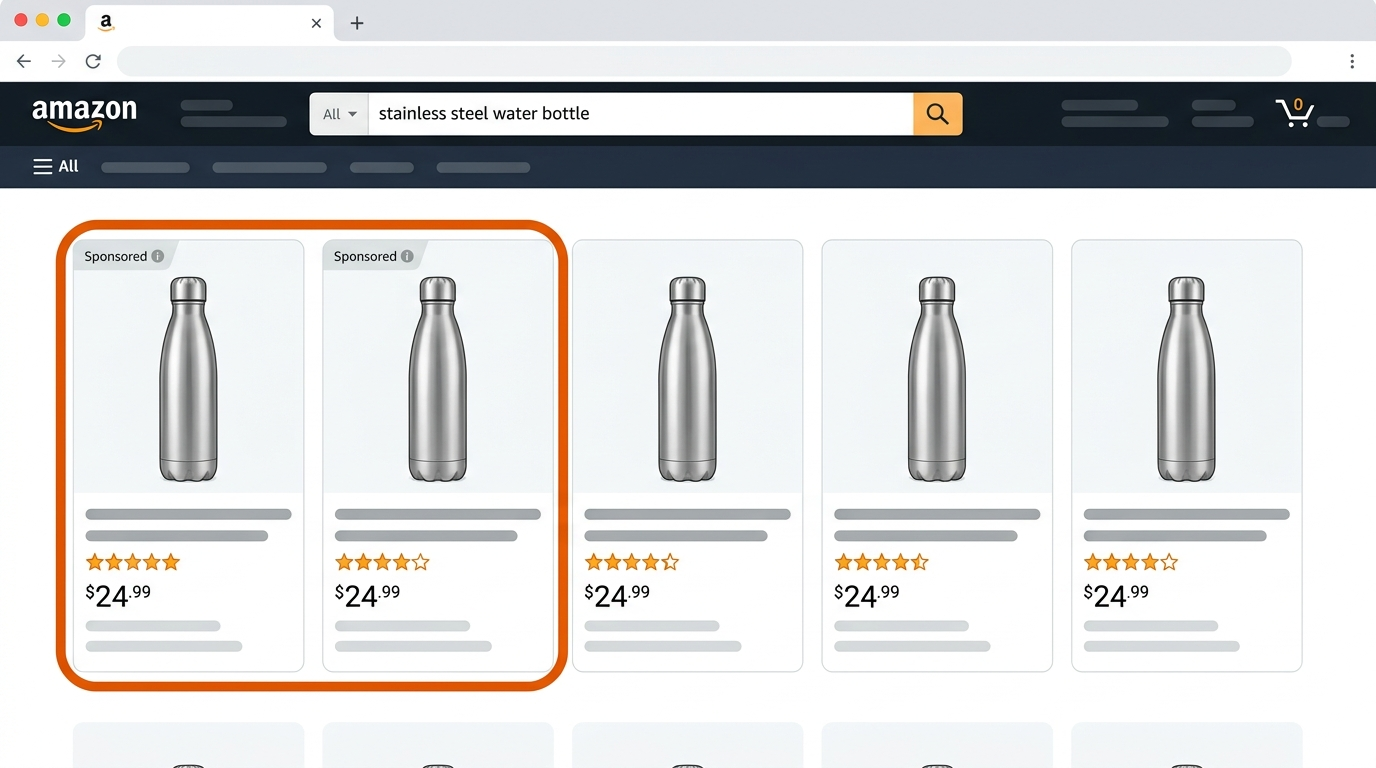
Think of it like paying for a prime shelf position in a giant store, except you only pay rent when someone actually picks your product off the shelf. When a shopper searches for “stainless steel water bottle,” the sponsored products at the top are Amazon PPC ads — those sellers bid to be there and pay a small fee each time someone clicks.
Why Amazon PPC Matters for Sellers
Amazon has millions of products, and organic ranking alone can take months to build — especially for a new listing with no sales history. PPC solves the “chicken and egg” problem: you need sales to rank organically, but you need to rank to get sales. Ads give your product immediate visibility so it can start generating the sales and reviews that fuel long-term organic ranking.
For most private label brands, PPC does three things at once:
Drives immediate visibility for new or low-ranking products.
Generates sales velocity that improves your organic keyword ranking over time.
Provides keyword data showing exactly which search terms convert into sales, which you can then use to optimize your listing.
PPC also feeds organic rank; our guide to Amazon PPC and organic ranking explains the flywheel.
Sponsored Products appear at the top of and within Amazon search results — these are PPC ads.
The Main Types of Amazon PPC Ads
Amazon offers three core ad types. Most sellers start with the first and expand as they grow.
Ad Type
Best For
Requires Brand Registry?
Sponsored Products
Promoting individual products; best starting point
TIP: Start with a single Sponsored Products automatic campaign before touching anything else. It costs less to learn on and it reveals which search terms convert before you commit budget to manual bids.
How Amazon PPC Bidding Works
Amazon runs an auction every time a shopper searches. Advertisers set a maximum bid — the most they are willing to pay for a click. The auction rewards a mix of bid amount and relevance, so a well-optimized listing can win good placements without always having the highest bid.
You can run campaigns two ways:
Automatic campaigns — Amazon decides which search terms to show your product for. Great for discovering keywords.
Manual campaigns — you choose the exact keywords and control bids. Precision once you know what converts.
Campaign Type
Best For
Automatic
Discovering which keywords convert
Manual
Scaling proven winners with bid control
The classic workflow uses both: run an automatic campaign to gather data, then move the best-performing search terms into a manual campaign for tighter control — and add the money-wasting terms as negative keywords.
COMMON MISTAKE: Judging a campaign after only 2–3 days. Amazon attribution lags, and a few clicks tell you almost nothing. Give a campaign at least 7–14 days and a meaningful number of clicks before you decide a keyword is a winner or a loser.
Key Amazon PPC Metrics (With Real Math)
A few metrics come up constantly. Here is what they mean — with numbers, because that is where it clicks.
ACoS (Advertising Cost of Sales): ad spend ÷ ad revenue. Spend $20 on ads, make $100 in ad sales → ACoS = 20%. Lower is usually better.
TACoS (Total Advertising Cost of Sales): ad spend ÷ total revenue (ads + organic). Spend $20 on ads, total revenue is $400 → TACoS = 5%. This shows whether ads are helping the whole business.
ROAS (Return on Ad Spend): ad revenue ÷ ad spend. $100 ÷ $20 = 5x. Just the flip side of ACoS.
CPC (Cost Per Click): what you pay per click on average.
A worked example. Say your product sells for $30, and after Amazon fees and product cost your profit before ads is $12. If your ACoS is 20%, you are spending $6 in ads per $30 sale — leaving $6 profit. Profitable. But if your ACoS climbs to 45%, that is $13.50 in ad spend per sale against $12 of margin — now you are losing $1.50 on every advertised unit, even though sales look healthy. This is why “more sales” from PPC can quietly lose money, and why you track ACoS against your real margin, not in isolation.
IMPORTANT: A low ACoS does not automatically mean a healthy business. A seller can hit a 12% ACoS by only bidding on their own brand name — great metric, almost no growth. The goal is profitable scale, not a pretty ACoS.
What Changed in Amazon PPC for 2026
A few shifts are worth knowing if your PPC knowledge is a year or two old:
Rufus, Amazon’s AI shopping assistant, now influences how shoppers discover products. Listings that clearly answer shopper questions are easier for AI to surface — meaning your listing optimization increasingly affects ad performance too.
More ad placements and ad types keep appearing across search and product pages, which means more competition for the same shopper attention and rising average CPCs in many categories.
Rising costs overall make efficiency matter more than ever — sloppy campaigns that survived on cheap clicks a few years ago now bleed money.
Is Amazon PPC Worth It?
For almost every serious Amazon seller, yes — but only when it is managed well. Poorly structured campaigns burn budget with little to show, which is why so many sellers feel PPC “does not work.” The problem is rarely PPC itself; it is structure, targeting, and bids that are not tied to actual profitability.
Run correctly, PPC is the difference between a product that sits on page 5 and one that climbs to page 1 and stays there. Realistically, results depend on your competition, pricing, reviews, and inventory levels — a well-run campaign on a weak listing or an out-of-stock product still will not perform. PPC amplifies a sound business; it does not rescue a broken one.
When Amazon PPC Is NOT the Right Move
Honest answer: PPC is not always the priority. Hold off or go slow when:
Your listing is not ready — poor images, thin copy, or a price that is not competitive. Fix the listing first, or you are paying to send traffic to a page that cannot convert.
You have very few or no reviews — shoppers hesitate on products with no social proof, so paid clicks convert poorly. Build a base of reviews first.
You are low on inventory — driving paid traffic to a product about to go out of stock wastes spend and hurts your ranking when you run dry.
Your margins are too thin — if there is almost no profit per unit, even a modest ACoS makes every advertised sale a loss.
Getting Started With Amazon PPC
If you are launching your first campaign, keep it simple: start with a Sponsored Products automatic campaign, set a modest daily budget you are comfortable testing with, let it run two weeks to gather data, then review which search terms produced sales. Move winners into a manual campaign and add poor performers as negative keywords.
From there it is an ongoing cycle of testing, refining, and scaling what works. If that sounds like a lot alongside running your business, that is where a dedicated team earns its keep. Our Amazon PPC management service handles structure, bids, and profitability tracking — and you can see the results on our client results page.
There is no fixed cost — you set your own daily budgets and bids. Many new sellers start testing with $10–$30 per day per product. What matters more than raw spend is your ACoS relative to your margin and whether the ads are profitable.
What is a good ACoS on Amazon?
It depends on your profit margins. A “good” ACoS is any figure that leaves you profitable after product and Amazon fees — for many sellers that is 15–30%, but a new product may accept a higher ACoS temporarily to build ranking and reviews.
How long does it take for Amazon PPC to work?
You will see clicks and impressions almost immediately, but meaningful optimization data takes about two weeks to gather. Most brands see campaigns become genuinely profitable within the first 4–8 weeks as data compounds and bids are refined.
Can I run Amazon PPC myself or should I hire help?
You can absolutely start yourself, and learning the basics is valuable. Many sellers bring in professional help once spend grows, accounts get complex, or they want their time back. It depends on your budget, time, and how quickly you want to scale.
What is the difference between automatic and manual campaigns?
In automatic campaigns Amazon chooses which search terms to target, ideal for discovery. In manual campaigns you select keywords and control bids, giving precision once you know what converts.
Written by the AMZ Scaler Team
Amazon advertising and listing specialists with 5+ years managing PPC and listing optimization for brands across the US, UK, and Canada. We publish what we apply in real seller accounts every day.