Getting your product in front of shoppers on Amazon comes down to two things: ranking for the right keywords and convincing people to buy once they land on your page. Listing optimization on Amazon is how you do both. This guide walks through every part of an optimized listing — with real examples, the mistakes that quietly cost sales, and what changed in 2026 — so your products rank higher and convert better.
Quick Answer
Listing optimization on Amazon is the process of improving your title, images, bullets, description, and backend keywords so your product ranks higher in search and converts more shoppers into buyers. It combines Amazon SEO (getting found) with conversion copywriting (getting the sale) — and the two reinforce each other.
Key Takeaways
Optimization does two jobs: get found (SEO) and get the sale (conversion).
Title and main image carry the most weight — fix those first.
Amazon rewards listings that convert, so better copy lifts ranking too.
Backend keywords let you index for terms you can’t fit in visible copy.
In 2026, clear listings also help Amazon’s Rufus AI surface your product.
Listing optimization on Amazon is the process of improving every element of your product page so it ranks for relevant search terms and turns visitors into buyers. It combines two disciplines: Amazon SEO (helping the algorithm understand and rank your product) and conversion copywriting (persuading the shopper to click “Add to Cart”).
A listing can be indexed for hundreds of keywords yet still fail because the copy does not convince anyone to buy. The reverse is also true — great copy that is not indexed for the right terms never gets seen. Real optimization handles both sides at once.
Why Listing Optimization Matters
Amazon’s ranking algorithm rewards listings that convert. When your page turns more clicks into sales, Amazon shows it to more shoppers, which creates more sales — a compounding loop. A poorly optimized listing does the opposite: it leaks traffic, drags down conversion, and quietly raises your advertising costs because every click is worth less.
This is why optimization and advertising work together. If you are running ads, you are paying for clicks that land on your listing — and if that listing does not convert, you are burning budget. (New to ads? See our guide on what Amazon PPC is.)
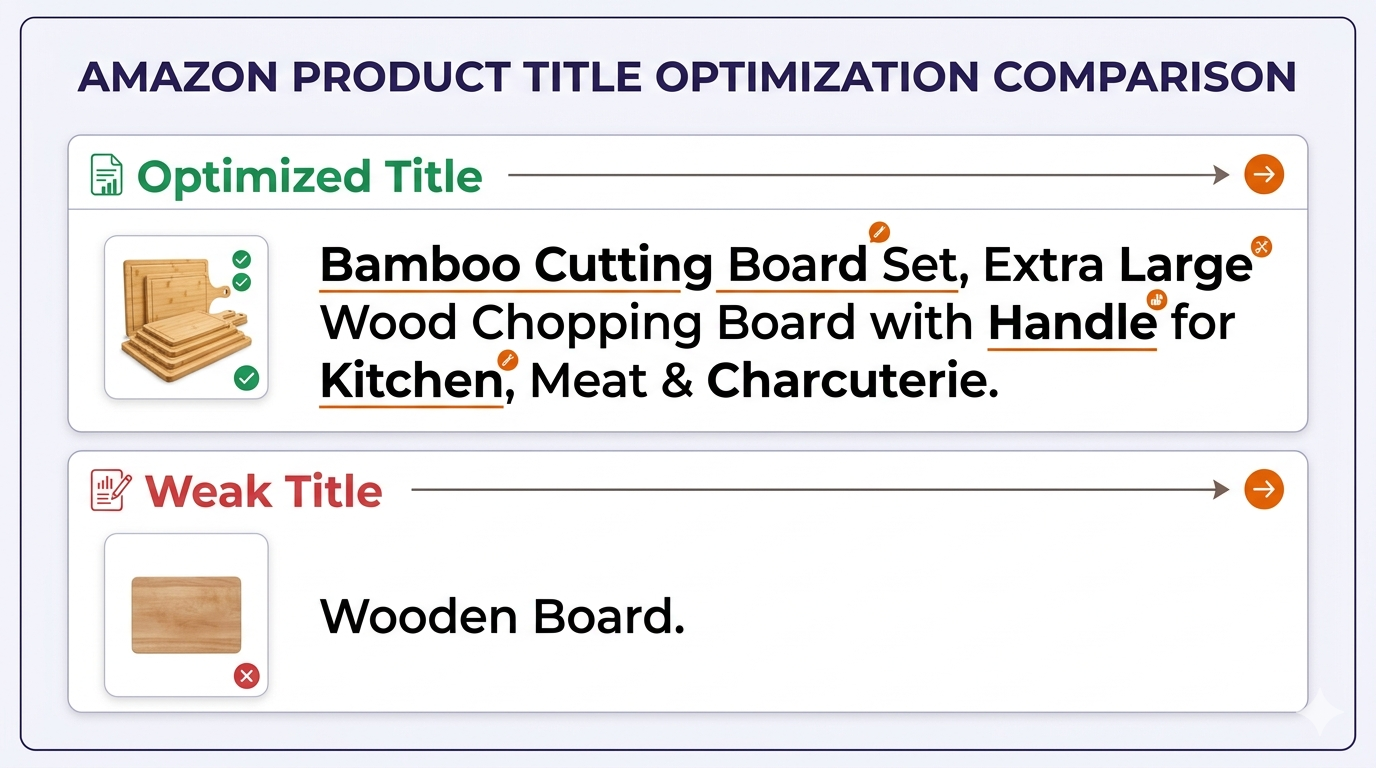
A keyword-rich, readable title (top) versus a vague one (bottom) — the difference in both ranking and click-through.
The Core Elements of an Optimized Listing
Every high-performing listing gets these six elements right.
Element
Main Job
Title
Ranking + click-through; lead with main keyword
Main image
Winning the click; clean product on white
Bullet points
Selling benefits, not just features
Description / A+
Storytelling, answering objections
Backend keywords
Indexing for terms not in visible copy
Reviews / rating
Social proof; drives conversion and ranking
TIP: Your main image is the single biggest lever on click-through rate. Before rewriting a word of copy, make sure your main image is a crisp, well-lit product shot that fills the frame — it often moves conversion more than anything else.
Amazon Keyword Research for Listings
Optimization starts with knowing what shoppers actually type. Good research finds terms with real search volume and buyer intent, then maps them across your title, bullets, and backend fields. The goal is full relevance coverage — your listing should be indexed for every reasonable way a customer might search.
A simple example. Say you sell a bamboo cutting board. Your priority order might be: put the highest-volume relevant term (“bamboo cutting board”) in the title; place supporting terms (“wood chopping board,” “kitchen cutting board with handle”) across the bullets; and send variations and synonyms you couldn’t fit naturally (“charcuterie board,” “butcher block”) to the backend search terms. One keyword, the right field — that is the whole game.
BACKEND KEYWORD EXAMPLE: Don’t repeat words already in your title (wasted space), don’t use competitor brand names (against Amazon policy), and skip commas. So instead of “bamboo, cutting, board,” write distinct new terms like “kitchen chopping serving charcuterie wood block” to maximize unique indexing.
Optimizing for Rufus and Amazon’s AI Search
Amazon has rolled out Rufus, an AI shopping assistant that answers shopper questions conversationally and recommends products. This changes listing optimization: Rufus reads your listing to decide whether your product answers a shopper’s question. Listings that clearly state who the product is for, what problem it solves, and how it compares are easier for Rufus to understand and surface.
Practically, write bullets and A+ Content that answer real questions (“Is this dishwasher safe?” “Will this fit a standard frame?”) in plain language. Brands that adapt now will have an edge as more shoppers rely on AI to choose products.
Common Listing Optimization Mistakes
COMMON MISTAKE: Writing features instead of benefits. “500ml stainless steel” is a feature. “Keeps drinks cold for 24 hours on the trail” is the benefit that sells. Lead every bullet with the outcome, then back it with the feature.
Keyword stuffing the title so it ranks but reads badly and kills click-through.
Weak gallery images that fail to show scale, use, and what’s included.
Ignoring backend search terms, leaving easy indexing on the table.
Never updating the listing as competitors and search behavior change.
When a Full Listing Overhaul Isn’t Necessary
Honest answer: not every listing needs a complete rebuild. Hold off on a full overhaul when:
Your listing already converts well and ranks on page 1 for its main terms — don’t fix what’s working; small tests beat a risky rewrite.
The real problem is price or reviews — no amount of copywriting fixes a product priced 40% above competitors or sitting at 3.2 stars.
You’re about to run out of stock — fix inventory first; optimizing a listing you can’t fulfill wastes the ranking boost.
Often a single strong improvement — a better main image, a rewritten first bullet — outperforms a full teardown.
Listing Optimization Is an Ongoing Process
The best listings are reviewed and refined regularly. Search trends shift, competitors update their pages, and conversion data reveals what is and isn’t working. Treat your listing as a living asset: test a new main image, rewrite an underperforming bullet, add missing keywords, and watch how ranking and conversion respond.
If managing all of this alongside running your business feels like a lot, that’s what we do. Our Amazon listing optimization service handles keyword research, copywriting, and Rufus-ready SEO — and you can see the gains it produces on our client results page.
A full optimization of one listing typically takes 7–14 days, covering keyword research, copywriting, and SEO structuring. The exact timeline depends on the number of products, category complexity, and the listing’s current state.
Does listing optimization improve ranking or just conversion?
Both. Proper keyword indexing improves ranking, while persuasive copy improves conversion — and because Amazon rewards listings that convert, the two reinforce each other.
Can I optimize an existing listing or only new ones?
Both. Existing listings often see fast gains because there is already traffic to convert better, while new listings benefit from being built right from day one.
What is the most important part of a listing?
The title and main image carry the most weight — the title for ranking and click-through, the main image for the click itself. That said, a listing wins on the whole package working together.
Do I need Brand Registry to optimize my listing?
No. You can optimize titles, bullets, descriptions, images, and backend terms without it. Brand Registry unlocks extra tools like A+ Content, but solid optimization is achievable without it.
Written by the AMZ Scaler Team
Amazon advertising and listing specialists with 5+ years managing PPC and listing optimization for brands across the US, UK, and Canada. We publish what we apply in real seller accounts every day.