Amazon is cutting product titles down to 75 characters, and the deadline is close. If you sell on Amazon, this change touches almost every listing you manage, and if you do nothing, Amazon’s AI will rewrite your titles for you. Here is exactly what is changing, what it means, and what to do before July 27, 2026.
Quick Answer
Starting July 27, 2026, Amazon is enforcing a 75-character limit on product titles in all categories except media (books, music, video). A new searchable “Item Highlights” field adds 125 characters for the details that no longer fit. After the deadline, titles still over 75 characters will be rewritten by Amazon’s AI, so it is far better to rewrite them yourself first.
What Changed
Amazon announced the update through Seller News on June 10, 2026. The core of it is simple. From July 27, 2026, product titles in every category except media need to be 75 characters or fewer, including spaces. For most sellers that is a big cut, since many categories previously allowed up to 200 characters and plenty of listings have grown to fill that space.
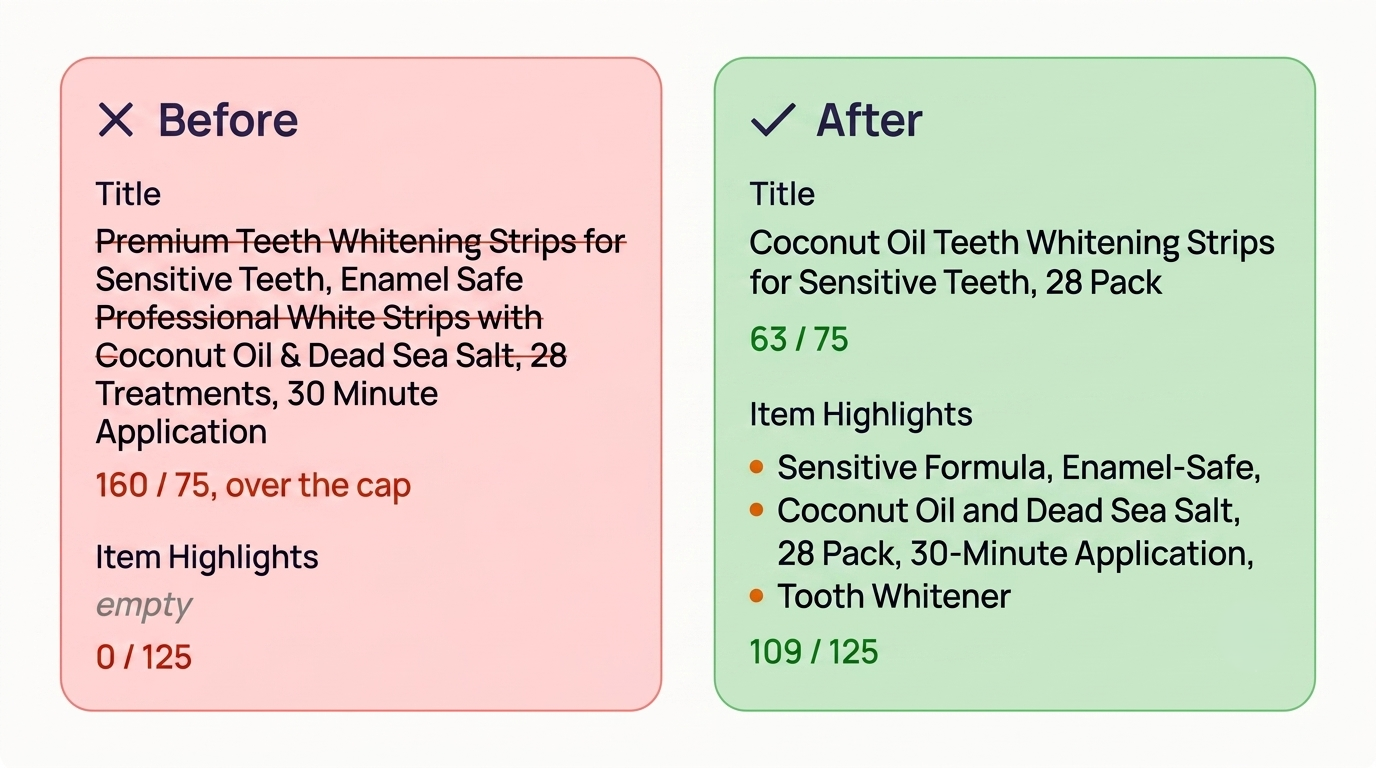
To make up for the lost room, Amazon is adding a new field called Item Highlights, which gives you an extra 125 characters for materials, recommended use cases, and comparison details. This field is searchable and shows up next to your title in search results and on the product detail page. So the total indexable space stays the same at 200 characters, just split into a 75-character title and a 125-character highlights field with different jobs.
A 160-character title now exceeds the cap. Splitting it into a 75-character title and 125 characters of Item Highlights keeps every keyword indexed.
What It Means for Sellers
The part that matters most: after July 27, any title still over 75 characters will be updated to Amazon’s AI-generated recommendation, gradually and on Amazon’s schedule. Your listing stays active, but Amazon writes the title. Brand owners get a 14-day window in Review Listings Changes to review, edit, and approve those AI suggestions before they go live, but sellers without Brand Registry have far less control.
In practice, this ends the title’s long-standing role as a keyword dumping ground. The title becomes a short identity field, and Item Highlights becomes the searchable home for the secondary keywords you have to move out. Details that no longer fit the title can go in the Amazon Item Highlights field.The sellers who plan the 75 and 125 split themselves keep control of their keywords. Everyone else finds out, gradually, what Amazon’s AI decided their listing was about.
What to Do Before July 27
You have a short window to own the rewrite instead of letting Amazon’s AI do it. Work through this:
Audit your catalog. Export your listings and filter for any title over 75 characters. Prioritize by revenue, your top sellers get your attention first.
Rewrite your top ASINs manually. For your best products, do not rely on the AI suggestion. Keep your brand, your core product descriptor, and the single most important converting keyword in the title.
Move secondary keywords to Item Highlights. It is searchable, so the keywords you remove from the title are not lost, they relocate. Treat it as a real content field, not overflow.
Use View enhancements as a reference, not a decision. In Manage All Inventory, select Edit on a listing and click View enhancements to see Amazon’s AI title and highlights. Use it to save time, but check every suggestion against your actual keywords.
Brand owners, watch Review Listings Changes. If Amazon does rewrite a title after the deadline, you have 14 days to review and correct it. Do not let that window pass unwatched.
IMPORTANT: Amazon’s AI title rewrites usually hit the character limit cleanly, but they often drop the specific keyword combinations you have tested and that actually drive your sales. That is the real risk of doing nothing. The AI optimizes for the character count, not for your revenue. Rewrite your top listings yourself before July 27 so you keep the keywords that matter. Our guide on Amazon product title optimization walks through how to build a strong title within the new limit.
The Bigger Picture
This change is not happening in isolation. Item Highlights being searchable, and the shift toward shorter, cleaner, mobile-friendly listings, fits the wider move toward AI-driven shopping on Amazon. As assistants like Alexa for Shopping (formerly Rufus) read listings to recommend products, clear and well-structured content matters more than a keyword-stuffed title ever did. Treating this as just a formatting task misses the point. It is a chance to rebuild your titles for how Amazon and its shoppers actually work now.
When does Amazon’s 75-character title limit start?
July 27, 2026. From that date, product titles in all categories except media (books, music, and video) must be 75 characters or fewer, including spaces. You can update your titles now or keep your existing ones until the deadline.
What is the Item Highlights field?
It is a new field giving you 125 additional searchable characters for materials, use cases, and comparison details that no longer fit in the shorter title. It appears alongside your title in search results and on the product detail page, so the keywords you move there are still indexed.
What happens if I do not update my titles?
After July 27, Amazon will gradually rewrite any title still over 75 characters using its AI recommendation. Your listing stays active, but Amazon chooses the wording. Brand owners get 14 days to review and edit those changes; other sellers have less control, so it is better to rewrite your top titles yourself first.
Written by the AMZ Scaler Team
Amazon advertising and listing specialists with 5+ years managing PPC and listing optimization for brands across the US, UK, and Canada. We publish what we apply in real seller accounts every day.