If you use AI-generated people in your Amazon images, a new law now affects you. As of June 9, 2026, New York requires advertisers to disclose when an ad uses an AI-generated human, and the penalties are real. Most sellers assume this is a big-brand problem. It is not. Here is what the law says, who it applies to, and what to do about your listings.
Quick Answer
New York’s synthetic performer law, effective June 9, 2026, requires a conspicuous disclosure when an advertisement features an AI-generated human that is not a real, identifiable person. Penalties are $1,000 for a first violation and $5,000 for each one after. It applies to any advertiser whose ads reach New York consumers, regardless of where the business is based, so most Amazon sellers using AI lifestyle images are in scope.
IMPORTANT: This article explains the law in plain terms for Amazon sellers. It is not legal advice. The law is new and its finer points are still being interpreted, so confirm your specific situation with a qualified attorney before relying on anything here.
What the Law Says
On December 11, 2025, New York signed a first-in-the-nation law (amending General Business Law section 396-b) that took effect June 9, 2026. It requires anyone who produces or creates an advertisement for a commercial purpose to conspicuously disclose when that ad includes a “synthetic performer,” where the advertiser has actual knowledge it is used.
A synthetic performer is, in plain terms, a digitally created human that is meant to look like a real person performing in the ad, but who is not any identifiable real individual. Think an AI-generated “model,” a fake “customer,” or a synthetic “spokesperson.” The trigger is not AI use in general. Background generation, image editing, or non-human graphics likely fall outside the law. The trigger is a fake human made to look real.
Who It Applies To
This is the part most sellers miss. The law applies to any company whose advertising reaches consumers in New York, regardless of where that company is based. Since Amazon listings are visible to shoppers nationwide, a seller anywhere, including outside the US, can be in scope if their listing reaches a New York buyer. The penalties are $1,000 for a first violation and $5,000 for each subsequent one. Enforcement is expected to rest with the New York attorney general rather than private lawsuits, as the law does not create an express private right of action.
Two Different Risks, Do Not Confuse Them
There are two separate issues sellers lump together, and they carry different consequences:
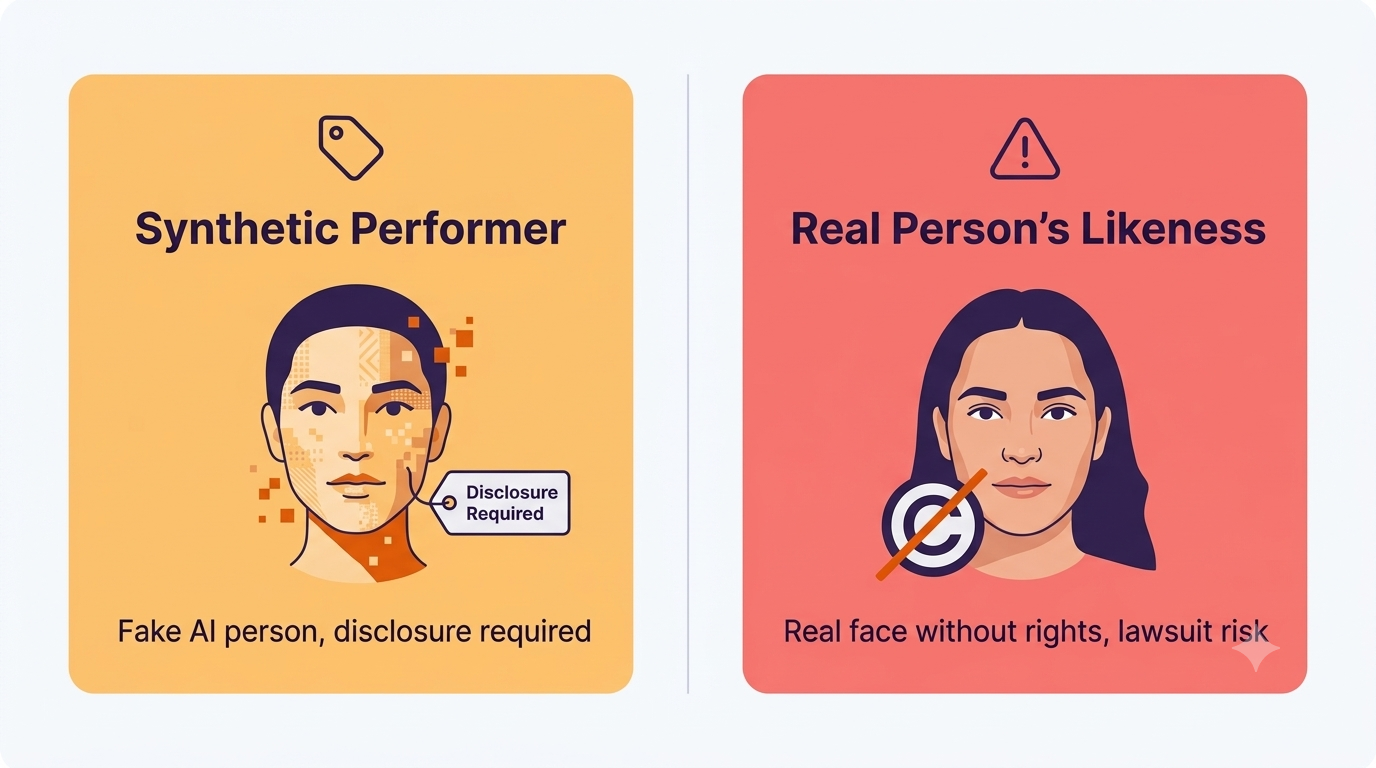
A fully AI-generated person (a synthetic performer). This is what the New York disclosure law covers. If you knowingly use one in a listing that reaches New York, you need a conspicuous disclosure.
A real person’s face used or re-created without their permission. That is a different and often more serious problem, a right-of-publicity or likeness issue that can lead to a lawsuit, separate from this disclosure law. Using a real model’s image, or an AI re-creation of one, without the rights is its own risk.
The disclosure law is about transparency. The likeness issue is about permission. You can be exposed to one, the other, or both.
Two separate risks. A fully AI-generated person needs a disclosure. A real person’s face used without rights is a different problem entirely.
The Exceptions
The law does have carve-outs. It does not apply to audio-only ads, to cases where AI is used solely to translate a human performer’s language, or to advertising for expressive works (like films or games) where the synthetic performer’s use matches the underlying work. Publishers and platforms that merely distribute an ad are also protected. For most Amazon sellers using AI lifestyle imagery, though, none of these exceptions apply. On Amazon itself, images with AI-generated people now need the Amazon synthetic performer tag.
What to Do Now
You do not need to panic. You need a checklist, run consistently:
Audit your active listings for any image containing an AI-generated human, a model, a “customer,” a face that is not a real person.
Add a clear disclosure wherever a synthetic performer appears, or replace the image with one that does not use a fake human. The law does not dictate exact wording, but the disclosure must be conspicuous and easy for a shopper to notice.
Confirm your rights anywhere a real person appears, so you are covered on the separate likeness issue, not just the disclosure one.
Check what your agency or designer used. If a third party made your creative, confirm whether AI-generated people are in it, and who is responsible for compliance.
Build a review step into your process so every new image is checked before it goes live. This is the fix that stops the problem recurring.
TIP: This pairs with a related move by Amazon itself, which has started asking sellers to flag AI-generated imagery in A+ Content and Brand Story uploads. The direction of travel is clear: AI imagery increasingly needs to be labeled. Building an AI-disclosure habit now keeps you ahead of both the law and the platform. Our guide on using AI for listings with human review covers how to keep AI work safe and compliant.
Why This Matters Beyond New York
New York is first, but rarely last. It is a bellwether for advertising and consumer-protection rules, and other states often follow. Treating AI-image disclosure as a standard part of your creative process now, rather than scrambling state by state later, is the practical move. AI imagery is a legitimate, cost-effective tool. The point is to use it with your eyes open.
Does the New York AI law apply to me if I am not in New York?
It can. The law applies to any advertiser whose ads reach consumers in New York, regardless of where the business is based. Since Amazon listings reach shoppers nationwide, sellers outside New York, and even outside the US, can be in scope. This is general information, not legal advice; confirm your situation with an attorney.
What exactly triggers the disclosure requirement?
A “synthetic performer,” meaning a digitally created human made to look like a real person performing in the ad, who is not an identifiable real individual. General AI use like background generation or image editing likely does not trigger it. A fake AI human does.
What are the penalties?
Civil penalties of $1,000 for a first violation and $5,000 for each subsequent violation. Enforcement is expected to come from the New York attorney general, as the law does not create an express private right of action.
How should I disclose an AI-generated person?
The law requires the disclosure to be conspicuous, meaning easy for a shopper to notice and understand, but it does not specify exact wording or placement. Plain language such as identifying the image as AI-generated is the safe direction. Consult legal counsel for your specific format.
Is using AI images on Amazon still allowed?
Yes. AI imagery is a legitimate tool. The law is about disclosing synthetic humans, not banning AI. The practical step is to audit your listings, disclose where a synthetic person appears, confirm rights for any real person, and build a review habit going forward.
Written by the AMZ Scaler Team
Amazon advertising and listing specialists with 5+ years managing PPC and listing optimization for brands across the US, UK, and Canada. We publish what we apply in real seller accounts every day.