If you ship your own orders to Amazon Business customers, a new requirement now has a date and a penalty attached. Starting September 30, 2026, Amazon requires a Business Hour Delivery Rate of 90% or higher on seller-fulfilled shipments to Business buyers in the US, and offers that stay below the bar past October 30 can be deactivated for those customers. Here is what changed, who it affects, and how to protect your offers.
Quick Answer
From September 30, 2026, seller-fulfilled shipments to Amazon Business customers in the US must maintain a Business Hour Delivery Rate (BHDR) of 90% or higher, measured over a rolling 14-day period. If your rate is below 90% on September 30, Amazon notifies you with recommendations. If it has not improved by October 30, your seller-fulfilled offers may be deactivated for Amazon Business customers. FBA offers and regular retail orders are not affected.
What Changed
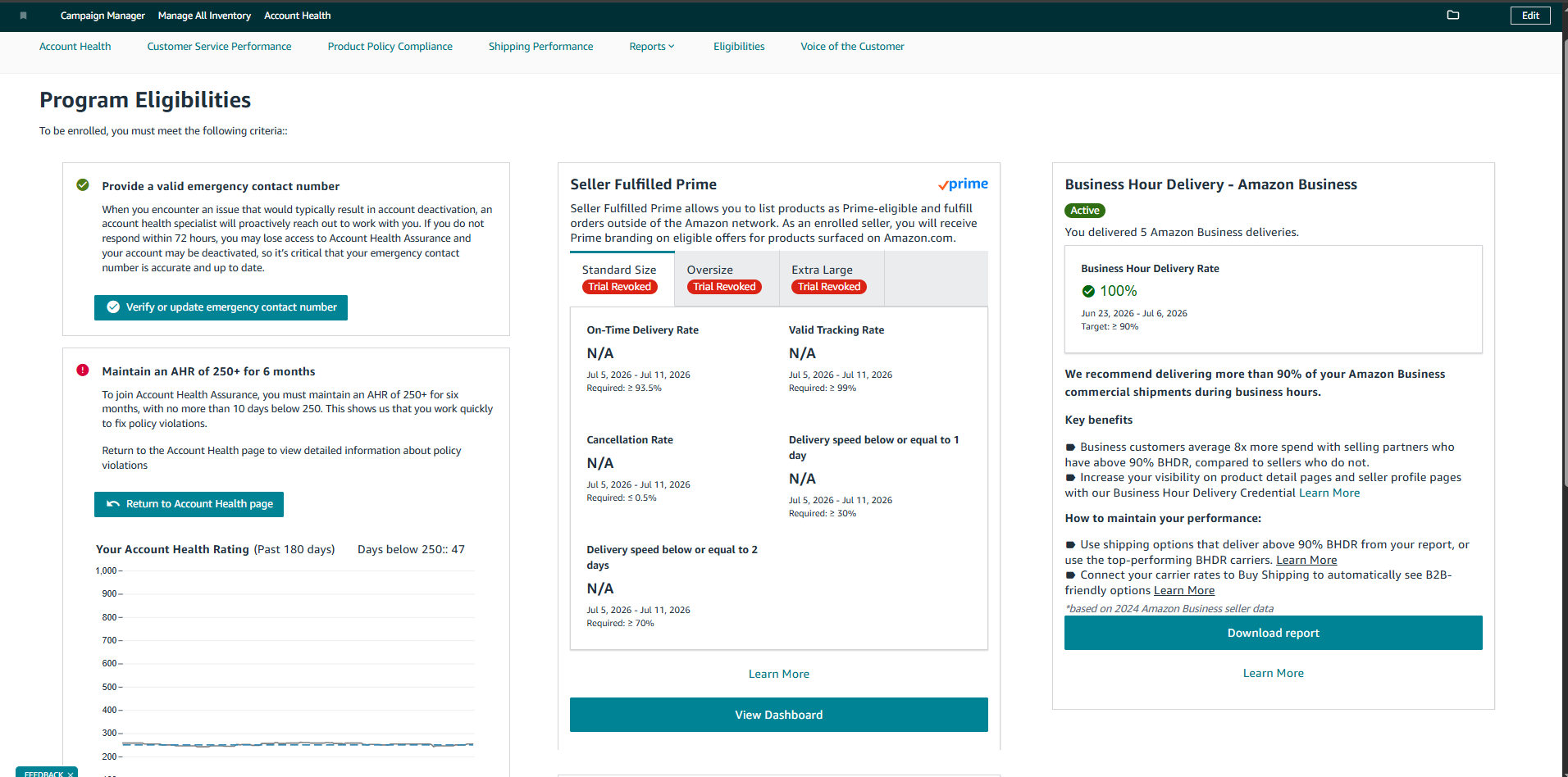
The Business Hour Delivery Rate metric itself is not new. It has been visible in the Eligibilities section of the Account Health dashboard, measuring how often your seller-fulfilled orders reach Amazon Business customers during their stated operating hours, offices, warehouses, schools, and other commercial addresses that cannot receive a package at 9 pm. What changed is enforcement. Until now, BHDR was informational. From September 30, 2026, it becomes a requirement with a 90% threshold and a real consequence: continued underperformance past October 30 can deactivate your seller-fulfilled offers for Business customers specifically.
Amazon’s reasoning is that business buyers need deliveries during working hours to avoid unattended packages, failed delivery attempts, and losses. The metric is calculated over a rolling 14-day window, so a bad stretch moves your number quickly, in both directions.
The Business Hour Delivery Rate card in Account Health, Program Eligibilities, showing the rolling measurement window and the 90% target. The Download report button breaks performance down by carrier.
What It Means for Sellers
The scope is narrower than it first sounds, and that matters. FBA offers are untouched. Regular retail orders are untouched. This applies only to seller-fulfilled orders going to Amazon Business customers. If B2B is a small slice of your FBM volume, the account-wide risk is limited. If Business buyers are a meaningful share of your seller-fulfilled sales, this is now an account health metric you manage weekly.
There is a fair criticism worth acknowledging: sellers do not drive the trucks. Once a package is with UPS or FedEx, the exact delivery hour is out of your hands, and sellers have pushed back on being measured against carrier behavior. Amazon’s counter is that carrier choice, handling time accuracy, and shipping settings are within your control, and its own data shows some carriers hit business hours far more reliably than others. Fair or not, the requirement is coming, so the practical move is to control the inputs you do own.
What to Do Before September 30
Check your current BHDR now. Go to Account Health, then Program Eligibilities, and download the BHDR report. If it shows N/A, you had no qualifying Business shipments in the window and this change is low priority for you.
Identify your best carriers. The report breaks performance down by carrier. In the US, Amazon recommends UPS Ground, UPS Ground Saver, and FedEx Ground for business hour reliability. Shift Business orders toward whichever carrier your own data shows performing above 90%.
Tighten the settings Amazon rewards. Accurate handling times, Automated Handling Time, Shipping Settings Automation, and buying labels through Amazon Buy Shipping all improve delivery predictability, and Amazon points to them as the fix.
Watch the metric weekly from now through October. The rolling 14-day window means problems and fixes both show up fast. Do not wait for the September 30 notification to find out where you stand.
Weigh FBA for your Business-heavy SKUs. If certain products sell disproportionately to Business buyers and your BHDR will not reliably clear 90%, moving those SKUs to FBA removes them from the requirement entirely.
IMPORTANT: This lands on top of the FBM handling time requirement that took effect June 29, 2026. Amazon is tightening the entire seller-fulfilled operating standard, delivery promises, handling accuracy, and now delivery timing. If you run FBM at any scale, treat these as one combined compliance project, not separate announcements. Our post on the Amazon FBM handling time update covers the other half.
BHDR measures the percentage of your seller-fulfilled shipments to Amazon Business customers that are delivered during the customer’s operating hours, calculated over a rolling 14-day period. It is visible in the Eligibilities section of your Account Health dashboard.
When does the 90% requirement start?
September 30, 2026. If your rate is below 90% on that date, Amazon notifies you and recommends improvements. If it has not improved by October 30, 2026, your seller-fulfilled offers may be deactivated for Amazon Business customers.
Does this affect FBA or regular retail orders?
No. FBA offers and standard retail orders are not covered. The requirement applies only to seller-fulfilled shipments going to Amazon Business customers in the US store.
How do I improve my BHDR?
Download the BHDR report from Account Health, identify which carriers deliver during business hours most reliably, and route Business orders to them. Amazon also recommends accurate handling times, Automated Handling Time, Shipping Settings Automation, and Amazon Buy Shipping.
Written by the AMZ Scaler Team
Amazon advertising and listing specialists with 5+ years managing PPC and listing optimization for brands across the US, UK, and Canada. We publish what we apply in real seller accounts every day.