Artificial intelligence has changed how Amazon listings get written, optimized, and even discovered. From AI writing tools to Amazon’s own Rufus shopping assistant, sellers now have powerful ways to optimize faster — and new factors to optimize for. This guide explains AI Amazon listing optimization in 2026: what it is, how to do it well, and the one thing that still separates great listings from generic ones.
Quick Answer
AI Amazon listing optimization means using AI tools to research keywords, draft and refine listing copy, and structure pages so they rank and convert — combined with optimizing for Amazon’s AI search (Rufus). The winning approach is AI speed plus human review: AI does the heavy lifting, a human ensures accuracy, compliance, and persuasion.
Key Takeaways
AI speeds up research, drafting, and Rufus-readiness checks.
AI invents features and writes generically — never publish unedited.
Rufus now reads listings to recommend products to shoppers.
Accuracy and compliance still require human judgment.
AI Amazon listing optimization is the use of artificial intelligence tools to research keywords, write and refine listing copy, and structure product pages — combined with optimizing for Amazon’s AI-driven search features like Rufus. It’s not about replacing strategy with a robot; it’s about using AI to do the heavy lifting faster while a human keeps quality, accuracy, and brand voice intact.
New to the fundamentals? Our complete guide to listing optimization on Amazon covers the core elements first. This guide focuses on the AI layer on top.
Why AI Matters for Listing Optimization in 2026
Two shifts make AI essential rather than optional. First, AI writing and research tools have collapsed the time to produce a well-structured, keyword-rich listing from days to hours. Second — and more importantly — Amazon itself now uses AI to help shoppers find products. Rufus reads listings and answers shopper questions conversationally, which means your listing is no longer optimized only for a keyword-matching algorithm but for an AI that needs to understand your product.
Sellers who treat optimization as a purely keyword game are already falling behind. The brands winning in 2026 write listings that are both keyword-relevant and genuinely informative — because that’s what both shoppers and AI reward.
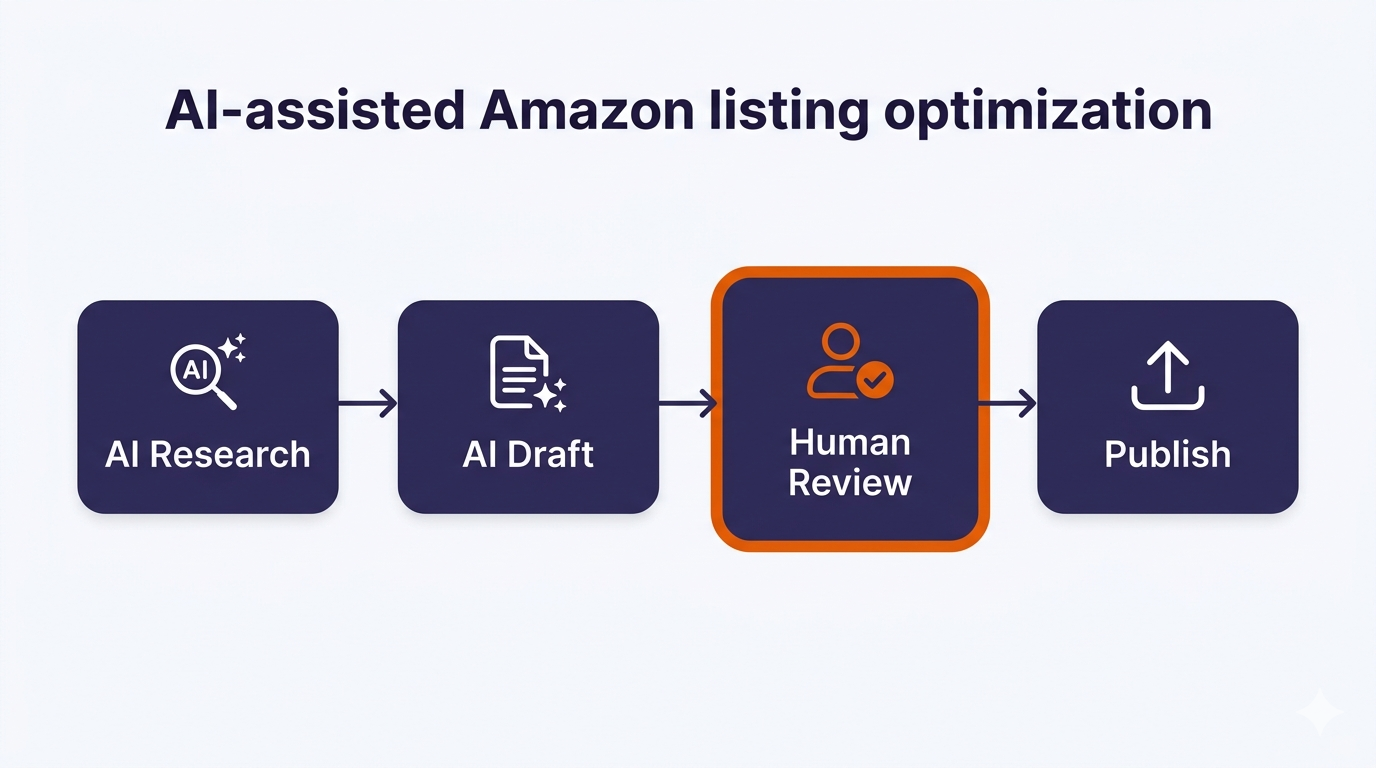
The AI-assisted listing workflow: AI handles research and drafting, a human verifies and refines before publishing.
How to Use AI for Amazon Listing Optimization
1. Keyword research and clustering. AI tools can take a raw keyword export and instantly group it into themes, spot gaps, and suggest related terms you missed — turning hours of spreadsheet work into minutes. You still decide which clusters match your product. AI proposes, you dispose.
2. Drafting titles, bullets, and descriptions. Feed an AI tool your product details, target keywords, and benefits, and it drafts copy in seconds. The draft is your starting point, not your final copy — AI is excellent at structure but tends toward generic phrasing.
3. Optimizing for readability and persuasion. AI can rewrite a bullet to be clearer or more benefit-led and check that your copy answers common shopper questions. Use it to tighten — but always read the result as a human buyer would.
4. Structuring for Rufus. Ask AI to review your listing the way Rufus might: does it clearly state who the product is for, what it solves, and how it compares? Then add the missing answers.
TIP: Always feed the AI your real product specs before asking it to write. The number one cause of bad AI listings is the model guessing details you never gave it — give it accurate inputs and the output improves dramatically.
Which AI Tools Help With Listing Optimization?
A range of tools now assist — general assistants like ChatGPT, Claude, Gemini, and Perplexity for research and copywriting, plus Amazon-specific platforms that combine keyword data with AI generation. For a side-by-side comparison, see our guide to the best AI tools for Amazon listing optimization. They all share one limitation, which leads to the most important point in this guide.
The Critical Role of Human Review
AI is fast and tireless, but it makes confident mistakes. It can invent product features that don’t exist, misstate dimensions, miss compliance issues, or produce copy that reads like every other listing in the category. On Amazon, where a single inaccurate claim can trigger a suppression or a bad review, unreviewed AI content is a real risk.
The winning approach is AI speed with human review. Let AI handle research, structure, and first drafts; let an experienced human verify accuracy, inject brand voice, confirm compliance, and make the copy genuinely persuasive. This is exactly how we approach it — AI accelerates the work, but every listing we produce is reviewed by a human before it goes live. Our Amazon listing optimization service is built on this balance, and you can see the results on our client results page.
Common Mistakes With AI Listing Optimization
COMMON MISTAKE: Letting AI invent specifications. It will confidently write “made from premium food-grade silicone” even if you never said that — and a false material claim can get your listing suppressed. Verify every spec, material, and dimension against the real product.
Publishing AI copy unedited — generic phrasing and possible errors hurt conversion and trust.
Ignoring compliance — AI doesn’t always know Amazon’s category rules and restricted-claim policies.
Keyword stuffing because AI makes it easy — relevance and readability matter, not keyword volume.
Forgetting Rufus — optimizing only for keyword matching leaves AI-search visibility on the table.
When to Be Cautious With AI
AI isn’t the right tool for every part of the job. Be especially careful when:
Making compliance-sensitive claims (health, safety, “organic,” “FDA approved”) — verify these manually against Amazon policy; never trust AI here.
Writing for highly technical products where a wrong spec misleads buyers — AI guesses, and guesses get returned.
Your brand voice is a key differentiator — generic AI phrasing can flatten what makes you distinct.
AI can draft a complete listing in seconds, but it shouldn’t be published unedited. The draft needs human review to verify accuracy, ensure compliance, add brand voice, and make the copy genuinely persuasive rather than generic.
Is AI-generated listing content against Amazon’s rules?
No, Amazon doesn’t prohibit AI-assisted content. What matters is that the content is accurate, compliant, and not misleading. The risk is publishing unverified claims — which is why human review is essential.
What is Rufus and how does it affect my listing?
Rufus is Amazon’s AI shopping assistant that answers shopper questions and recommends products. It reads your listing to decide whether your product fits a shopper’s need, so listings that clearly state who the product is for are easier for Rufus to surface.
Which AI tool is best for Amazon listings?
There’s no single best tool — general assistants like ChatGPT and Claude are strong for research and copywriting, while Amazon-specific platforms add keyword data. The best choice depends on your workflow; we compare them in our dedicated guide.
Should I optimize myself with AI or hire a service?
You can do it yourself if you have time to research, edit carefully, and verify compliance. Many brands prefer a service because the combination of AI speed and expert human review produces better, safer results faster — especially across multiple listings.
Written by the AMZ Scaler Team
Amazon advertising and listing specialists with 5+ years managing PPC and listing optimization for brands across the US, UK, and Canada. We publish what we apply in real seller accounts every day.