
On August 31, 2026, the Federal Trade Commission and 22 state attorneys general sued Amazon, alleging the company secretly inflated what advertisers pay for Sponsored Products, Sponsored Brands, and Sponsored Display. If you run Amazon ads, the Amazon FTC ads lawsuit is about the auction you bid in every day. Nothing has been proven, Amazon strongly disputes the claims, and the case will take a long time. But it raises a question every advertiser should be able to answer: do you actually know what your clicks are worth?
Quick Answer
The FTC’s Amazon ads lawsuit alleges that since a 2019 auction change, Amazon used hidden surcharges to push up the price of sponsored ads, affecting about 1.2 million advertisers and extracting more than $20 billion. Amazon denies it and says inflation-adjusted cost per click has stayed flat. These are allegations, not findings. The practical response for sellers is not to panic or pause ads, but to bid from your own unit economics and keep good records of your ad costs.
IMPORTANT: This article summarizes a pending lawsuit in plain terms for sellers. It is not legal or financial advice, and the allegations have not been proven in court. If you have questions about your own rights or any claims process, speak with a qualified attorney.
What the FTC Alleges
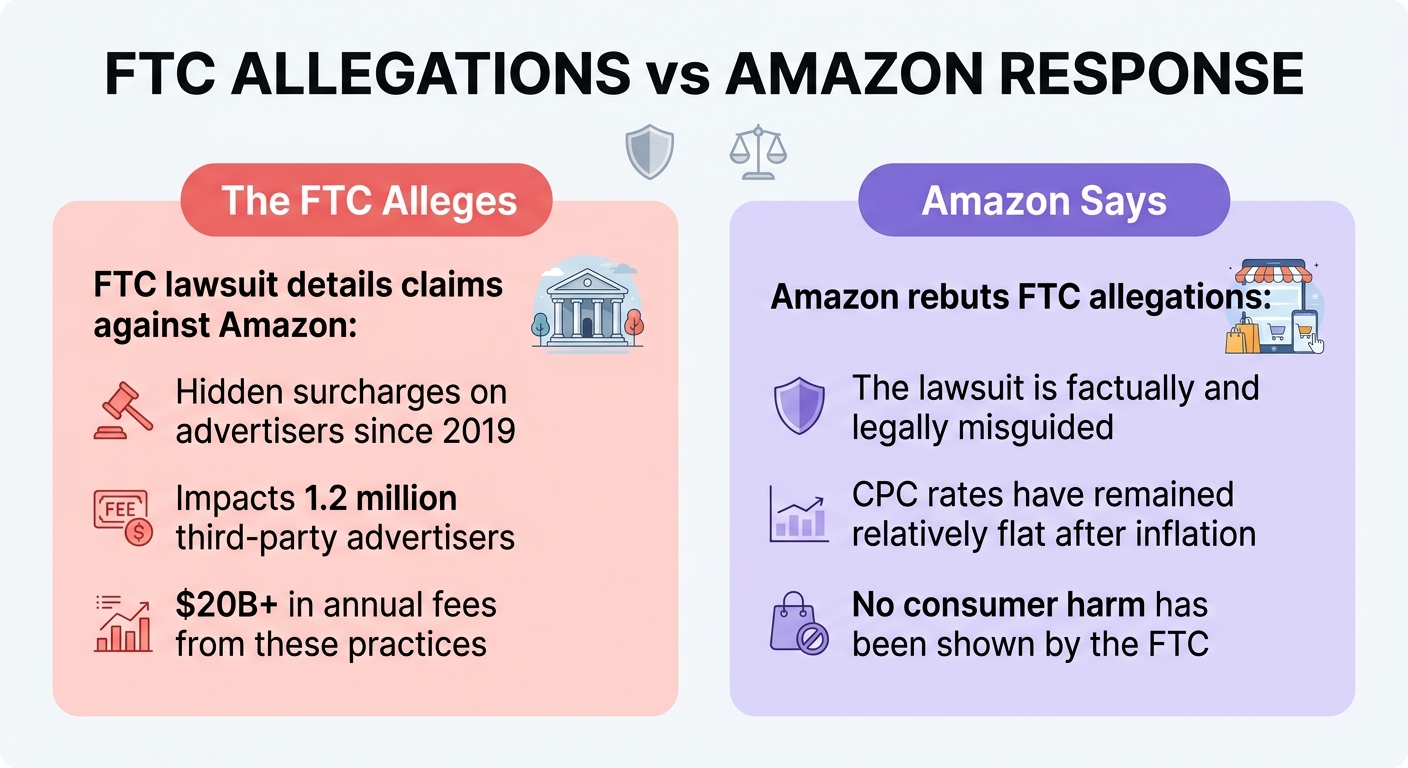
The complaint, filed in federal court in Seattle (case FTC v. Amazon, 26-cv-3097), makes several core allegations:- Inflated auction prices. The FTC and states say Amazon secretly raised prices in its search ad auctions for Sponsored Products, Sponsored Brands, and Sponsored Display, starting with an auction rule change in 2019.
- Scale. The complaint says roughly 1.2 million advertising customers were affected, including more than 500,000 small and medium businesses, and puts the total at more than $20 billion.
- Concealment. It alleges Amazon gave misleading answers to advertisers who asked whether the auction format had changed.
- Amazon’s position. Amazon calls the suit misguided, says the FTC cherry-picked findings, and states that ad quality improved while inflation-adjusted cost per click stayed flat.
What It Means for Amazon Sellers
In the short term, very little changes in your account. The auction still runs, your campaigns still serve, and the case could take years to resolve. What it does is put a spotlight on something many sellers already felt: CPCs have crept up, and most advertisers bid based on Amazon’s suggested bid rather than their own numbers. That is the real lesson here, regardless of how the case ends. If your bids are anchored to what Amazon suggests, you have no independent way to judge whether a click is worth its price. Sellers who calculate their own maximum bid from margin and conversion rate are protected no matter how the auction is priced, because they simply refuse clicks that do not pay.What to Do Now
- Do not pause profitable campaigns over headlines. A lawsuit is not a reason to switch off ads that are making you money.
- Set bids from your own economics. Work out your break-even ACoS and the most you can pay per click at your real conversion rate. Our guide on what a good ACoS is shows the starting math.
- Track CPC over time. Export monthly campaign reports and watch cost per click by campaign and keyword. Trend data tells you far more than a single month.
- Keep your billing and campaign records. Download and store your invoices and campaign performance reports. Good records are simply sound practice, and useful if anything about this case ever affects advertisers directly.
- Cut the waste you control. Whatever the auction does, non-converting search terms are money you can recover today. See where wasted ad spend hides.
TIP: The strongest defense against any pricing you cannot see is a bid ceiling you can. If you manage your ads with a clear maximum CPC per keyword, you stop overpaying automatically, whoever sets the price. This is exactly how our PPC management work is built: bids tied to margin, not to suggestions.
Frequently Asked Questions
What is the FTC lawsuit against Amazon about?
The FTC and 22 states allege Amazon secretly inflated auction prices for Sponsored Products, Sponsored Brands, and Sponsored Display since a 2019 auction change, overcharging about 1.2 million advertisers by more than $20 billion. Amazon denies the claims. The case is pending and nothing has been proven.Should I stop advertising on Amazon because of the lawsuit?
No. The lawsuit does not change how your campaigns work today. Keep running campaigns that are profitable, set bids from your own margin and conversion rate, and cut non-converting spend. Those steps protect you regardless of the outcome.Will advertisers get refunds?
Nobody knows yet. The case was filed on August 31, 2026 and could take years. Any remedy would depend on how the court rules or whether there is a settlement. Keep your billing records, and consult an attorney if you have specific questions.Written by the AMZ Scaler Team
Amazon advertising and listing specialists with 5+ years managing PPC and listing optimization for brands across the US, UK, and Canada. We publish what we apply in real seller accounts every day.