A backend field you probably never filled in may now be pulling your listings down in search. In mid-2026, Amazon’s Listing Quality Dashboard began actively influencing organic rank, and its newest component, the Attribute Completeness Score, rewards listings that fully populate Amazon’s catalog fields and quietly penalizes the ones that do not. Most sellers never completed these fields because they were optional at listing creation. Here is what changed, why it matters for rank and the Buy Box, and what to fix first.
Quick Answer
Amazon’s Listing Quality Dashboard scores every ASIN across several components, including a new Attribute Completeness Score that measures how fully you have filled your product’s catalog attributes. As of mid-2026 this score is tied to organic rank, and in some regulated categories, low scores are linked to Buy Box suppression. The fix is to populate the backend attribute fields (material, use case, dimensions, certifications) that most sellers left blank, starting with your top-revenue ASINs.
What Changed
The Listing Quality Dashboard has existed in Seller Central for a while as a place that flags missing content and compliance gaps. What changed in mid-2026 is its weight. Industry reporting in early July 2026 tied the dashboard’s Listing Quality Score directly to organic rank movement, meaning it stopped being a cosmetic checklist and started influencing where your products actually appear in search.
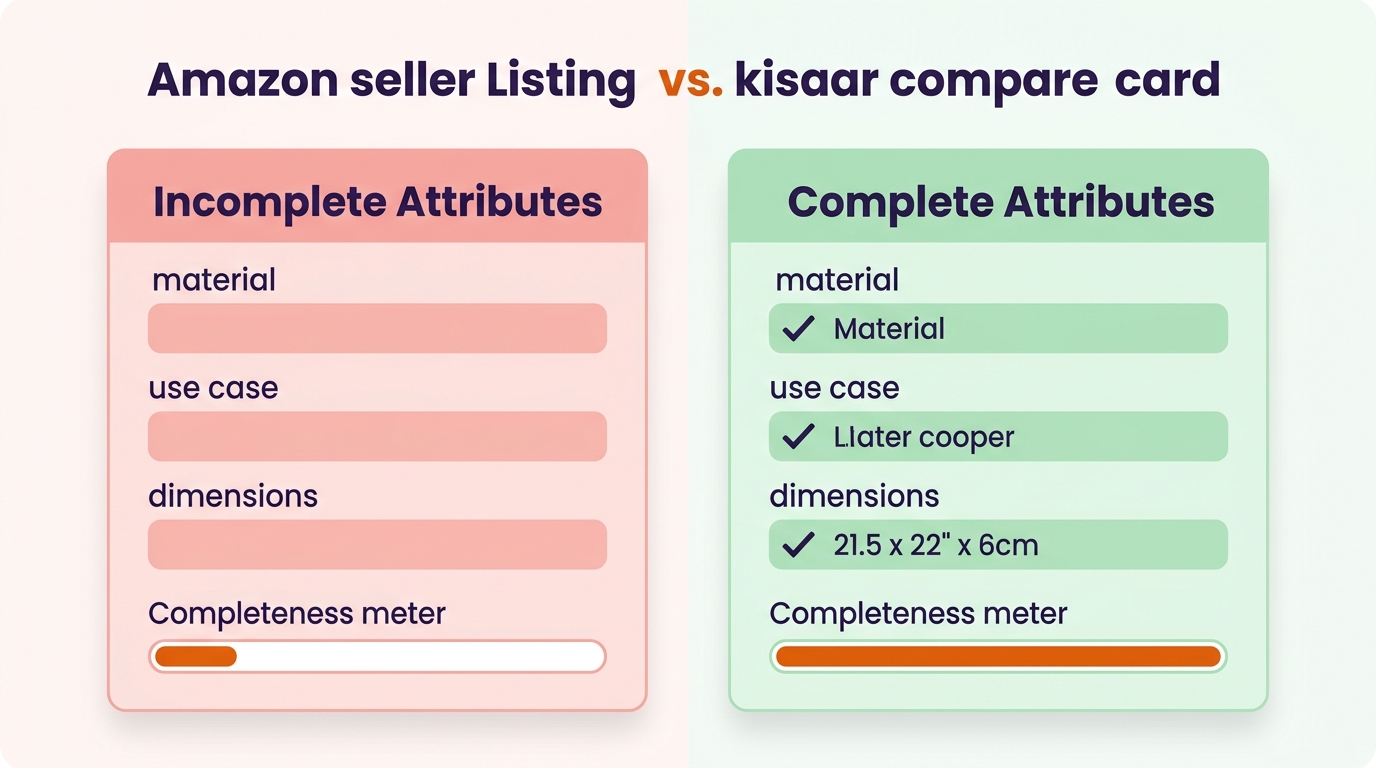
The dashboard grades each ASIN across several components, including image quality, title compliance, bullet completeness, A+ Content presence, and review health. The operationally new one is the Attribute Completeness Score. It measures how many of the structured catalog fields for your product, drawn from Amazon’s full category taxonomy, you have actually filled in. These are backend fields like material, intended use, compatibility, size, and certifications. Most sellers never completed them because they were not required to publish a listing. Now they carry weight.
amazon listing complete versus incomplete attributes comparison
What It Means for Sellers
This connects to a bigger shift. Amazon and the AI assistants shoppers increasingly use both rely on structured, complete product data to understand and recommend products. A listing with rich, accurate attributes is easier for Amazon’s systems, and for AI shopping agents, to read and trust. Incomplete listings look ambiguous, and ambiguous listings get shown less.
The practical impact is real. Early field data circulating in the seller community suggested ASINs with low attribute completeness lost organic positions over a few weeks, and that in regulated categories like grocery, health, and beauty, very low scores were appearing alongside a Buy Box suppression status tied to listing quality. Treat those specific figures as directional rather than official, they come from third-party analysis, not an Amazon announcement, but the direction is consistent across sources: complete attributes help, missing ones increasingly hurt.
What to Do About It
Open the Listing Quality Dashboard and export it. Find it in Seller Central, review the scores across your catalog, and export the list so you can prioritize.
Fix your top-revenue ASINs first. A low score on a low-velocity product is not urgent. A low score on a product driving real sales is. Sort by revenue and start at the top.
Fill the backend attribute fields. Download the current flat file template for each category you sell in, and complete the material, use-case, dimension, compatibility, and certification fields. These are the ones most sellers skipped.
Match your claims to structured fields. Every claim in your title and bullets should have a matching structured attribute behind it, not just free text. If your bullets say “stainless steel,” the material attribute should say so too.
Prioritize regulated categories. If you sell in grocery, health, beauty, or similar, treat low scores as a same-week task, since these categories are where quality-linked suppression has been showing up.
Check images against attributes. Make sure pack count, variant, and dimension data in your attributes do not contradict what your images show. Conflicts lower quality signals.
IMPORTANT: This is the cheapest ranking work available right now. Filling attribute fields costs nothing but time, does not require new creative or ad budget, and addresses a factor Amazon is actively weighting. Before spending more on ads to fix a visibility problem, check whether the real issue is an incomplete listing. Our listing optimization checklist covers the full picture.
It is a component of Amazon’s Listing Quality Dashboard that measures how fully you have populated your product’s structured catalog attributes, fields like material, use case, dimensions, and certifications drawn from Amazon’s category taxonomy. Many of these were optional at listing creation, so a lot of sellers left them blank.
Does listing quality really affect organic rank now?
Industry reporting from mid-2026 tied the Listing Quality Score to organic rank movement, so it appears to carry real weight rather than being a cosmetic checklist. Some third-party analysis also linked very low scores to Buy Box suppression in regulated categories. Treat specific figures as directional, but the pattern across sources is consistent.
Where do I fix my attributes?
Start in the Listing Quality Dashboard in Seller Central to find flagged ASINs, then use the category flat file template to fill in the missing attribute fields. Prioritize your highest-revenue products and any listings in regulated categories.
Written by the AMZ Scaler Team
Amazon advertising and listing specialists with 5+ years managing PPC and listing optimization for brands across the US, UK, and Canada. We publish what we apply in real seller accounts every day.