AI can draft an Amazon listing in seconds, but a draft is not a finished listing. The sellers getting real results from AI are not the ones who paste whatever the tool produces. They use a clear workflow: AI for speed, a human for accuracy and persuasion. This guide walks through exactly how to use AI for Amazon listing optimization the right way, step by step, with the human review step that keeps it safe and effective.
Quick Answer
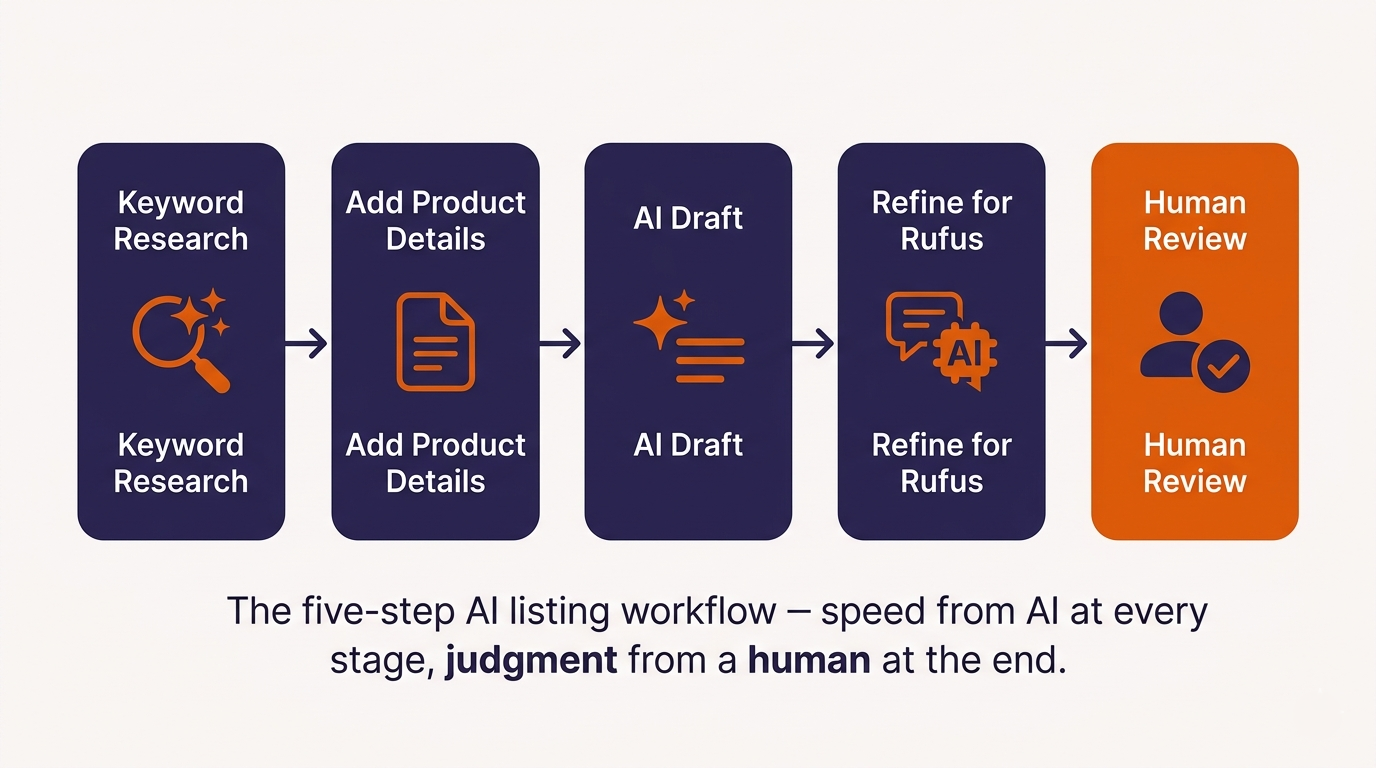
To use AI for Amazon listing optimization: research keywords with AI, feed the tool your real product details, have it draft the title, bullets, and description, then refine for persuasion and Rufus-readiness. Finish with human review to verify accuracy, ensure compliance, and add brand voice before publishing. AI handles speed; the human handles judgment.
Key Takeaways
Give AI real product specs — most bad output comes from missing inputs.
Use AI for research, drafting, and refining; not final publishing.
Always do a human review pass for accuracy and compliance.
Check the listing answers shopper questions for Rufus.
The workflow, not the tool, is what produces good listings.
Most disappointing AI listings come from one mistake: treating AI like a vending machine. You type “write me an Amazon listing for a water bottle,” paste the result, and wonder why it sounds like every other listing and contains a feature your product does not have. A workflow fixes this by giving AI the right inputs at each stage and keeping a human in control of the output. If you want the bigger picture first, see our complete guide to AI Amazon listing optimization.
Step 1: Use AI for Keyword Research
Start by gathering keywords, then let AI organize them. Paste a raw keyword list into an AI tool and ask it to group the terms into themes, flag duplicates, and suggest related searches you might have missed. This turns an hour of spreadsheet sorting into a few minutes. You stay in charge of deciding which clusters actually match your product and buyer intent.
The five-step AI listing workflow — speed from AI at every stage, judgment from a human at the end.
Step 2: Feed AI Your Real Product Details
This is the step most people skip, and it is the single biggest factor in output quality. Before asking AI to write anything, give it the facts: exact dimensions, materials, what’s in the box, key features, who the product is for, and your target keywords. The more accurate detail you provide, the less the AI invents.
Not sure which tool to start with? For a tool-by-tool breakdown, see our guide to the best AI tools for Amazon listing optimization.
TIP: Paste a few of your best competitor reviews into the AI along with your product details. The AI can spot the language real buyers use and the objections they raise, then write copy that answers them. This is one of the fastest ways to make AI copy feel genuinely relevant.
Step 3: Draft the Title, Bullets, and Description
Now ask the AI to draft each element with its keywords in mind: a keyword-led but readable title, five benefit-first bullets, and a description or A+ outline. Treat everything it produces as a first draft. AI is excellent at structure and speed here, which saves you the blank-page problem, but the phrasing will usually need tightening.
Step 4: Refine for Persuasion and Rufus
Take the draft and push it further. Ask the AI to rewrite each bullet to lead with the benefit, then back it with the feature. Then check for Rufus-readiness: does the listing clearly answer who the product is for, what problem it solves, and how it compares? Amazon’s Rufus AI reads listings to recommend products, so a listing that answers real questions is easier for it to surface.
Step 5: The Human Review Pass (Non-Negotiable)
This is where good listings are separated from risky ones. Before anything goes live, a human checks four things:
Accuracy — every spec, material, and claim matches the real product. AI invents details; you catch them.
Compliance — no restricted claims, no prohibited words, nothing against Amazon’s category rules.
Brand voice — the copy sounds like your brand, not a generic template.
Persuasion — it actually makes someone want to buy, not just lists features.
COMMON MISTAKE: Publishing AI copy that contains a claim you never verified. AI will confidently write “BPA-free” or “machine washable” even if you never said so. A single false claim can get your listing suppressed or trigger returns. The review pass exists to catch exactly this.
This AI-plus-human-review approach is exactly how we work. AI accelerates the research and drafting, but a specialist reviews every listing before it goes live. Our Amazon listing optimization service is built on this balance — and you can see the results on our client results page.
When to Skip AI Entirely
AI is not always the right tool. Lean on human expertise alone when:
Making regulated claims — supplements, medical, safety, or “organic” products where a wrong word breaks Amazon policy or the law.
Highly technical products where a single incorrect spec misleads buyers and drives returns.
Your brand voice is the differentiator and generic AI phrasing would flatten what makes you distinct.
You can automate the research and drafting, but not the final publishing. A human review pass for accuracy and compliance is essential, because AI can confidently produce false claims that risk suppression or returns.
What should I give AI before it writes my listing?
Give it your exact product details — dimensions, materials, what’s in the box, key features, target audience — plus your target keywords. The more accurate detail you provide, the less the AI invents and the better the draft.
How do I optimize an AI-written listing for Rufus?
Ask the AI to check whether the listing clearly answers who the product is for, what problem it solves, and how it compares. Rufus reads listings to recommend products, so answering real shopper questions helps it surface yours.
Which AI tool should I use for this workflow?
Strong writing models like ChatGPT or Claude work well for drafting, and research tools like Perplexity help with category understanding. The workflow matters more than the specific tool — we compare options in our best AI tools guide.
Is it safe to use AI for Amazon listings?
Yes, when you review the output. Amazon allows AI-assisted content; the risk is publishing unverified claims. A human review pass for accuracy and compliance keeps the process safe.
Written by the AMZ Scaler Team
Amazon advertising and listing specialists with 5+ years managing PPC and listing optimization for brands across the US, UK, and Canada. We publish what we apply in real seller accounts every day.