Most sellers ask the wrong question about Amazon growth. They ask whether to focus on PPC or organic ranking, as if the two compete for the same budget and only one can win. They do not compete. They feed each other. Understanding how Amazon PPC and organic ranking work together, the advertising flywheel, is what separates a product stuck at break-even from one that climbs to page one and stays there. This guide explains the mechanism and how to use it at each stage of a product’s life.
Quick Answer
Amazon PPC and organic ranking are not separate strategies, they are two halves of one system. PPC generates the early sales velocity that signals relevance to Amazon’s algorithm, which lifts your organic rank for those keywords. As organic rank climbs, more of your sales come free, and you can ease off paid spend. The catch: this only works when your PPC traffic actually converts, on keywords relevant to your product. Wasted spend does not build rank.
Key Takeaways
PPC and organic ranking feed each other; they do not compete.
PPC buys keyword-specific sales velocity, which lifts organic rank.
The flywheel only turns when PPC traffic converts on relevant terms.
Emphasis shifts from paid to organic as a product matures.
Listing quality decides whether any of it works, optimize first.
Asking whether PPC or organic ranking is better is like asking whether a car needs an engine or wheels. You need both to move. PPC gives you immediate, controllable visibility, you pay for clicks and appear near the top of search today. It costs more per sale at first, but it is the fastest way to generate sales on a new listing. Organic ranking is earned through sales history, conversion rate, relevance, and listing quality. Once you rank on page one for a valuable keyword, those sales cost nothing in ad spend, which transforms your margins.
The sellers who struggle are the ones trying to pick a side. The ones who scale understand these are phases of one strategy, not a fork in the road.
The Flywheel: How PPC Builds Organic Rank
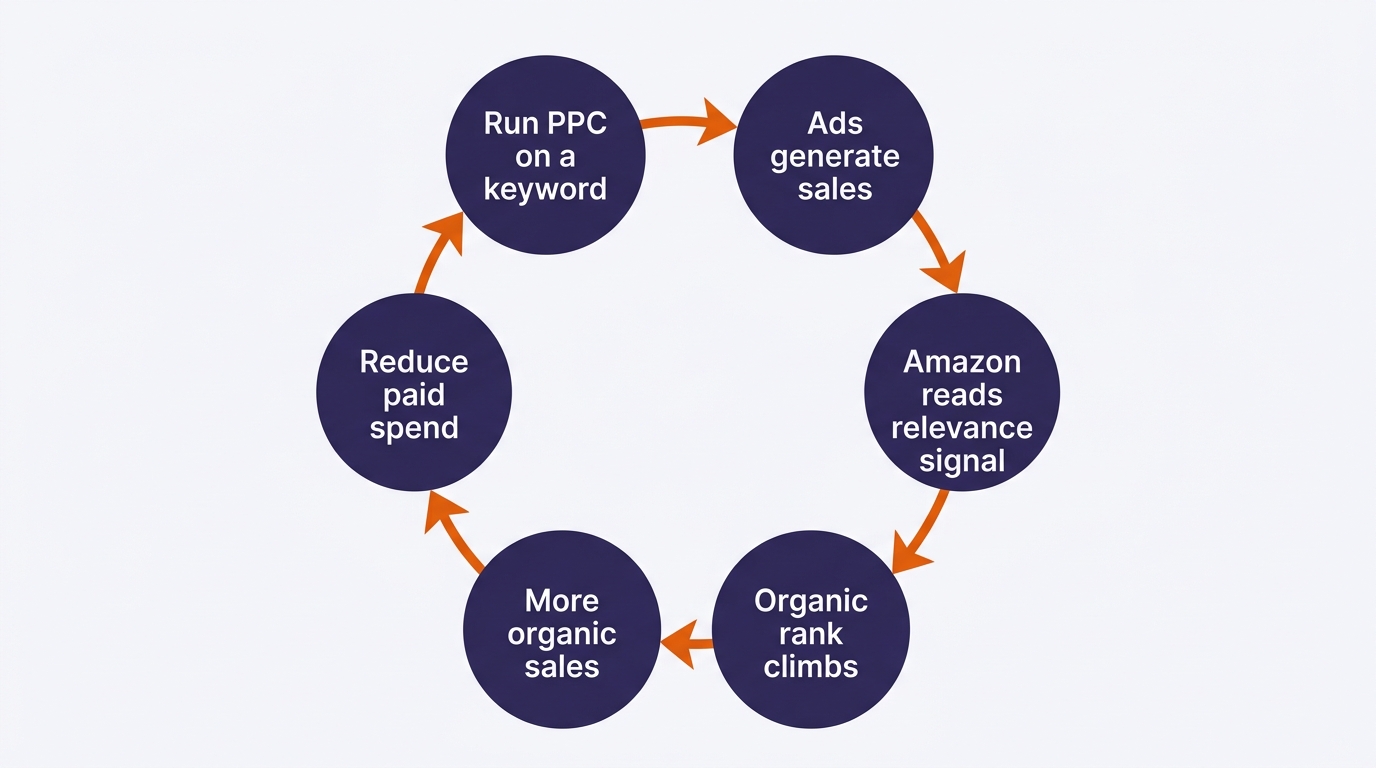
Here is the mechanism that changes how you should think about ad spend. PPC does not just buy sales. Done correctly, it directly improves your organic rank. The loop:
You run PPC targeting a specific keyword.
The ads generate clicks and, crucially, sales for that exact keyword.
Amazon’s algorithm reads a signal: this product converts well for this search term.
Your organic rank for that keyword improves.
Higher organic rank brings more organic impressions and sales.
That added sales velocity reinforces the rank further.
You can gradually reduce PPC spend while holding visibility.
The critical caveat, the one most sellers miss: this only works when your PPC traffic converts, on relevant keywords. Sales for a search term are what signal relevance. Clicks without sales, or sales on loosely related terms, do not build rank for the keywords you care about. This is why throwing budget at broad campaigns rarely moves organic position. The flywheel runs on relevant conversions, not spend.
Amazon PPC + Organic Flywheel
What to Do at Each Stage of a Product’s Life
The right blend of paid and organic shifts as a product matures. A useful way to think about it:
Stage
Focus
PPC Approach
Launch (early weeks)
Build sales velocity
Aggressive, higher ACoS tolerance, exact and phrase match on your highest-intent keywords
Ranking push
Climb for target keywords
Temporarily raise bids and budget on the specific terms you want to rank for; accept worse short-term profit
The shift is gradual. A new product might start heavily paid and move toward organic-dominant over its first year as rank builds. The exact ratios vary by category and competition, but the direction is consistent: paid carries you early, organic carries you later.
TIP: Track TACoS (total ad spend divided by total sales), not just ACoS. Falling TACoS over time is the clearest sign the flywheel is working: you are earning more total sales for each advertising dollar because organic is picking up the load. A low ACoS with a high, rising TACoS is the opposite signal, over-dependence on ads. Our guide on what TACoS is covers this in depth.
When the Flywheel Breaks
The system fails in predictable ways:
Trying to rank organically with no PPC support. In a competitive category, this takes far longer and often never breaks through. The algorithm favors products with sales history, and PPC is how a new listing builds that history.
Running PPC forever without optimizing for organic. You stay profitable but never escape paid dependency, because you are not converting the paid momentum into organic rank.
Cutting PPC entirely once you rank. Rank is harder to regain than to hold. Competitors outbid you, your position slips, and you lose the ability to defend and expand. Reduce PPC once ranked; do not eliminate it.
Sending PPC traffic to a listing that does not convert. This is the big one. PPC is an amplifier; your listing is the signal. Amplify a weak signal and it just gets louder, not better. If your images, title, bullets, and A+ Content do not convert, ad spend is wasted and organic rank never moves.
COMMON MISTAKE: Advertising before the listing is ready. Optimize your listing until it converts on its own, then use PPC to scale what already works. Driving paid traffic to a poorly converting page burns budget and, because those clicks do not turn into sales, does nothing for your organic rank. Listing first, ads second, always.
The Bottom Line
Stop choosing between PPC and organic. Use PPC deliberately to build keyword-specific sales velocity, optimize your listing so that traffic converts, and watch organic rank climb for the terms you targeted. Then ease paid spend down to a maintenance level while organic carries your growth and your margin. PPC is the catalyst; organic ranking is the payoff. Run them as one system and the economics of your whole catalog change.
It is possible but slow and difficult in competitive categories, often taking many months and sometimes never breaking through. Amazon’s algorithm favors products with sales history, and PPC is the most reliable way to generate that history early. Products that rank without ads usually have an unusual edge like strong external traffic or little competition.
How does PPC actually improve organic rank?
Indirectly, through sales velocity. When your ads generate sales for a specific keyword, Amazon reads that as a relevance signal and improves your organic rank for that term. The key is that the sales must be real conversions on relevant keywords. Clicks alone, or sales on unrelated terms, do not build rank.
Should I stop PPC once I rank on page one?
Reduce it, do not eliminate it. Shift to maintenance-level defensive campaigns that protect your position and capture peripheral keywords. Cutting PPC entirely lets competitors outbid you for placement and can cause your hard-won rank to slip, which is harder to rebuild than to defend.
What matters more, PPC or listing optimization?
Listing optimization comes first. PPC drives traffic, but if your listing does not convert that traffic, you waste budget and gain no organic rank. Optimize images, title, bullets, and A+ Content until the listing converts well on its own, then use PPC to scale what already works.
How do I know the flywheel is working?
Watch your paid-to-organic sales ratio and your TACoS over time. Rising organic sales and a falling TACoS mean organic is taking over the load and your ad efficiency is improving. If organic stays flat while ad spend climbs, the flywheel is not turning, usually a listing conversion or keyword relevance problem.
Written by the AMZ Scaler Team
Amazon advertising and listing specialists with 5+ years managing PPC and listing optimization for brands across the US, UK, and Canada. We publish what we apply in real seller accounts every day.