
A $30 product can look like a weak advertising bet on the first order and still be a very good business. If customers come back and buy again, the first sale is only the start of what each customer is worth. That is what Amazon customer lifetime value measures, and it changes how much you can afford to spend to win a new customer. This guide shows how to estimate lifetime value with Amazon’s own data, how to turn it into an ACoS target, and when it is a trap rather than a strategy.
Quick Answer
Amazon customer lifetime value is the total profit a customer brings over time, not just on the first order. Estimate it with the Repeat Purchase Behavior report in Brand Analytics: profit per order multiplied by the average number of orders per customer over a set period, such as 12 months. If customers reliably reorder, you can afford a higher ACoS on the first purchase than single-order math allows. Only use this for products with proven repeat purchases, and set a payback period you can fund.
Key Takeaways
- First-order ACoS ignores repeat purchases, so it undervalues consumables and refillable products.
- Lifetime value is profit per order times orders per customer over a fixed period, not revenue.
- The Repeat Purchase Behavior report in Brand Analytics shows what share of your customers and revenue comes from repeat orders.
- A lifetime-value ACoS target only works if you have the cash to wait for the repeat orders.
- Products bought once (furniture, most electronics) should be judged on first-order profit.
Table of Contents
- What Customer Lifetime Value Means on Amazon
- Where to Find Repeat Purchase Data
- How to Calculate It
- Turning Lifetime Value Into an ACoS Target
- How to Grow Lifetime Value
- When NOT to Use Lifetime Value
- Frequently Asked Questions
What Customer Lifetime Value Means on Amazon
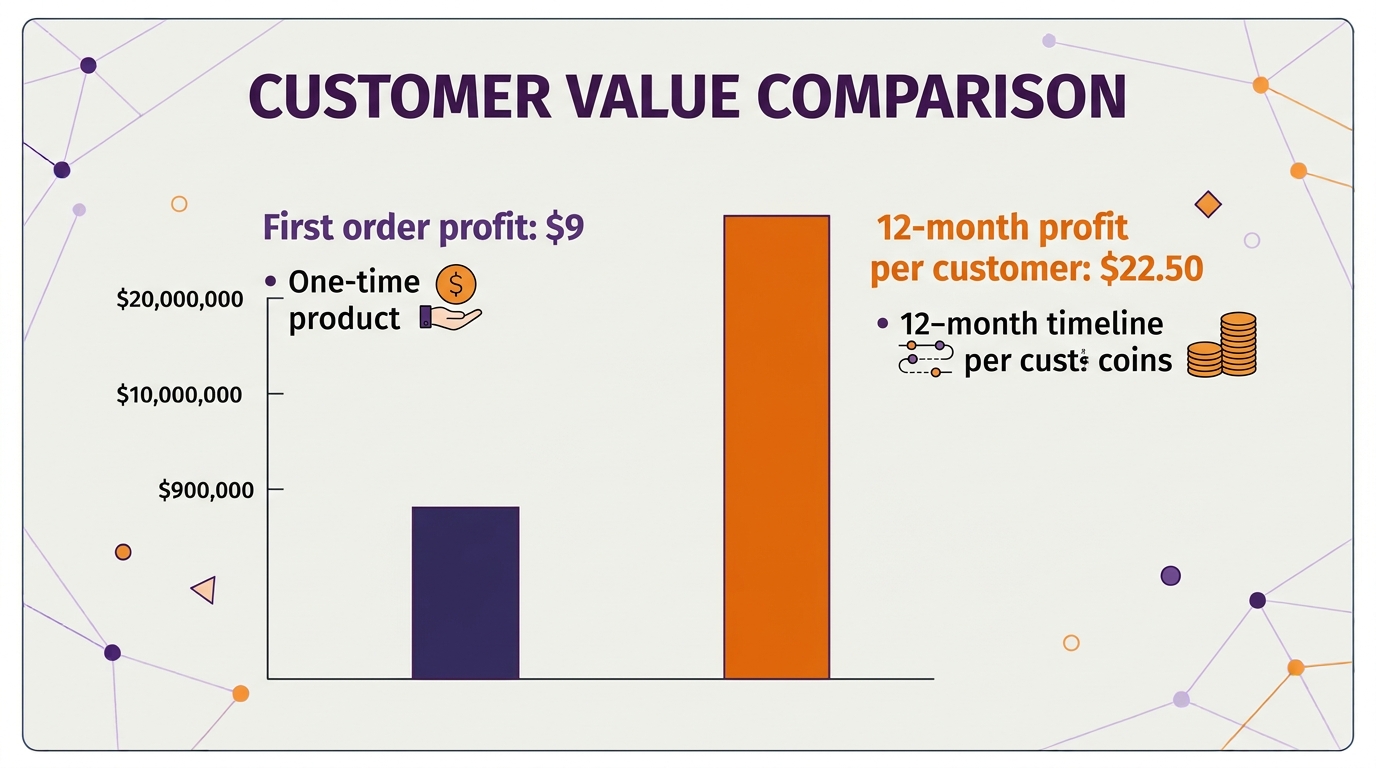
On Amazon, most sellers judge ads one order at a time. If a sale earns $9 of profit before ads and the ad cost $12, the campaign looks like a loss. But if that customer buys three more times over the next year, mostly without another ad click, the same campaign was profitable. Lifetime value is the number that captures that.
It is closely related to the new-to-brand metrics in Amazon Ads, which show how many orders came from customers buying your brand for the first time in the past year. New-to-brand tells you how many customers your ads acquire. Lifetime value tells you what each of them is worth.
Where to Find Repeat Purchase Data
- Repeat Purchase Behavior report (Brand Analytics): shows orders, unique customers, the share of customers who ordered more than once, and revenue from repeat purchases by ASIN for a chosen period (report breakdown). It needs Brand Registry, because Brand Analytics does.
- Subscribe and Save data: active subscriptions are the clearest repeat signal for consumables.
- Amazon Marketing Cloud: for brands with access, AMC can show how long customers take to reorder and which first purchases lead to more. See our AMC guide for sellers.
How to Calculate It
Keep it simple and conservative:
- Pick a period you are willing to wait for, usually 12 months.
- Find profit per order before ads, after all Amazon fees and landed cost.
- Find average orders per customer in that period from the repeat purchase data.
- Multiply: lifetime value = profit per order × average orders per customer.
| Input | Example |
|---|---|
| Selling price | $30.00 |
| Profit per order before ads | $9.00 |
| Average orders per customer over 12 months | 2.5 |
| 12-month profit per customer | $22.50 |
| First-order break-even ACoS | 30% |
These numbers are illustrative. Use your own, and round orders per customer down rather than up.
Turning Lifetime Value Into an ACoS Target
In the example, first-order break-even ACoS is 30%. But each new customer is worth $22.50 over a year, so you could in theory spend more than $9 to acquire them. In practice, set a middle target. For example, accept up to 40% to 45% ACoS on new-customer campaigns for this product, and keep strict break-even targets on campaigns that mostly reach existing customers, such as branded search. Our break-even CPC guide turns any target ACoS into a maximum bid, and TACoS is the check that tells you whether repeat orders are really arriving.
How to Grow Lifetime Value
- Enroll consumables in Subscribe and Save so the reorder is automatic.
- Offer larger pack sizes. Customers who start on a multi-pack often buy again more reliably.
- Keep stock steady. A stockout sends repeat buyers to a competitor, and some never come back.
- Build a product line. Related products give customers a reason to come back to your brand, not just the same item.
When NOT to Use Lifetime Value
- One-time purchases. If customers rarely buy the product twice, judge it on first-order profit.
- No repeat data yet. New products do not have a repeat rate. Use first-order math until you have several months of data.
- Tight cash. Lifetime value pays back over months. If you cannot fund the gap, a higher ACoS today can stall the business.
Related Reading
Frequently Asked Questions
What is customer lifetime value on Amazon?
It is the total profit a customer generates over a set period, usually 12 months, including repeat orders, not just the first purchase.
How do I find repeat purchase data on Amazon?
Brand-registered sellers can use the Repeat Purchase Behavior report in Brand Analytics, which shows the share of customers and revenue from repeat orders. Subscribe and Save data and Amazon Marketing Cloud add more detail.
Can I spend more on ads if customers reorder?
Yes, for products with proven repeat purchases. Set a higher ACoS target only for campaigns that acquire new customers, and only as far as your cash can wait for the repeat orders.
Is lifetime value useful for every product?
No. Products customers buy once should be judged on first-order profit. Lifetime value matters most for consumables and products with refills or accessories.
What is the difference between new-to-brand and lifetime value?
New-to-brand metrics show how many orders came from first-time customers of your brand. Lifetime value estimates what those customers are worth over time. Together they show whether acquiring customers through ads pays off.
Source: Amalytix, Repeat Purchase Behavior report explained.
See our brand scaling and growth service, our Amazon PPC management, and our client results.
Written by the AMZ Scaler Team
Amazon advertising and listing specialists with 5+ years managing PPC and listing optimization for brands across the US, UK, and Canada. We publish what we apply in real seller accounts every day.