
Quick Answer
A good Amazon PPC campaign structure separates campaigns by product role (hero, growth, launch, long tail) and by search intent (branded, category, competitor, discovery), with each search term owned by one campaign. Run auto and broad campaigns for discovery, move proven search terms into exact match, and add those terms as negative exact in the discovery campaigns so they stop competing. Group campaigns into portfolios by product line so budgets and reporting follow how the business is run.
Key Takeaways
- Structure by product role and by search intent, not by whatever was launched first.
- Every search term should have one owner campaign. Overlap makes your campaigns bid against each other and hides what is working.
- Discovery campaigns (auto, broad) feed exact match campaigns; negative exact keeps the two apart.
- Branded, category, and competitor traffic behave differently. Keep them in separate campaigns so each gets its own budget and target.
- Consolidate when campaigns are too thin to learn; rebuild when nobody can say which campaign owns which term.
Table of Contents
- Why Structure Matters More as You Add Products
- The Two Layers: Product Role and Search Intent
- A Blueprint for a 6-Product Brand
- Stopping Your Campaigns From Competing
- Portfolios, Budgets and Naming
- Pause, Consolidate or Rebuild? Decision Rules
- When NOT to Restructure
- Frequently Asked Questions
Why Structure Matters More as You Add Products
With one product, almost any structure works. With six to ten products, three problems appear. Budget flows to whichever campaign spends fastest, not to the product that earns most. Several campaigns bid on the same search term, so reports split the data and nobody can see the real ACoS of that term. And every change becomes risky, because nobody is sure what else it touches. Structure is not decoration. It decides where money goes, what you can measure, and how fast you can act. That is why our PPC audit checklist starts with it.The Two Layers: Product Role and Search Intent
Layer 1: product role
| Role | What it is | Ad goal |
|---|---|---|
| Hero | Your best seller, strong reviews and margin | Defend and grow rank on top terms; highest budget |
| Growth | Proven products with room to rank higher | Push selected terms toward page one |
| Launch | New products without sales history | Data and early sales; accept a higher ACoS for a set period |
| Long tail | Steady sellers with small search volume | Efficient, low-touch campaigns with strict ACoS targets |
Layer 2: search intent
| Intent | Example search | Campaign type |
|---|---|---|
| Branded | “[your brand] water bottle” | Exact match brand campaign plus Sponsored Brands |
| Category | “insulated water bottle 32 oz” | Exact and phrase match by keyword cluster |
| Competitor | Competitor brand names or ASINs | Product targeting campaign, kept separate |
| Discovery | Unknown new terms | Auto and broad match campaigns |
A Blueprint for a 6-Product Brand
Here is an illustrative structure for a brand with one hero, two growth products, one launch, and two long-tail products. Names follow a simple pattern: product | intent | match type.| Campaign | Targets | Budget share (example) |
|---|---|---|
| HERO | Brand | Exact | Brand + product terms | Small, always on |
| HERO | Category | Exact | Top 10 to 20 proven terms | Largest |
| HERO | Ranking | Exact | 2 to 3 terms you are pushing | Time-limited |
| GROWTH-A and GROWTH-B | Category | Exact | Proven terms per product | Medium each |
| ALL | Discovery | Auto | All products, separate ad groups | Small, steady |
| ALL | Discovery | Broad | Seed keywords per product | Small, steady |
| LAUNCH | Discovery + Exact | Auto plus core terms | Fixed launch budget |
| LONGTAIL | Exact | Proven terms, strict targets | Small |
| ALL | Competitor | Product targeting | Selected competitor ASINs | Small, tested |
| BRAND | Sponsored Brands | Brand and top category terms | Medium |
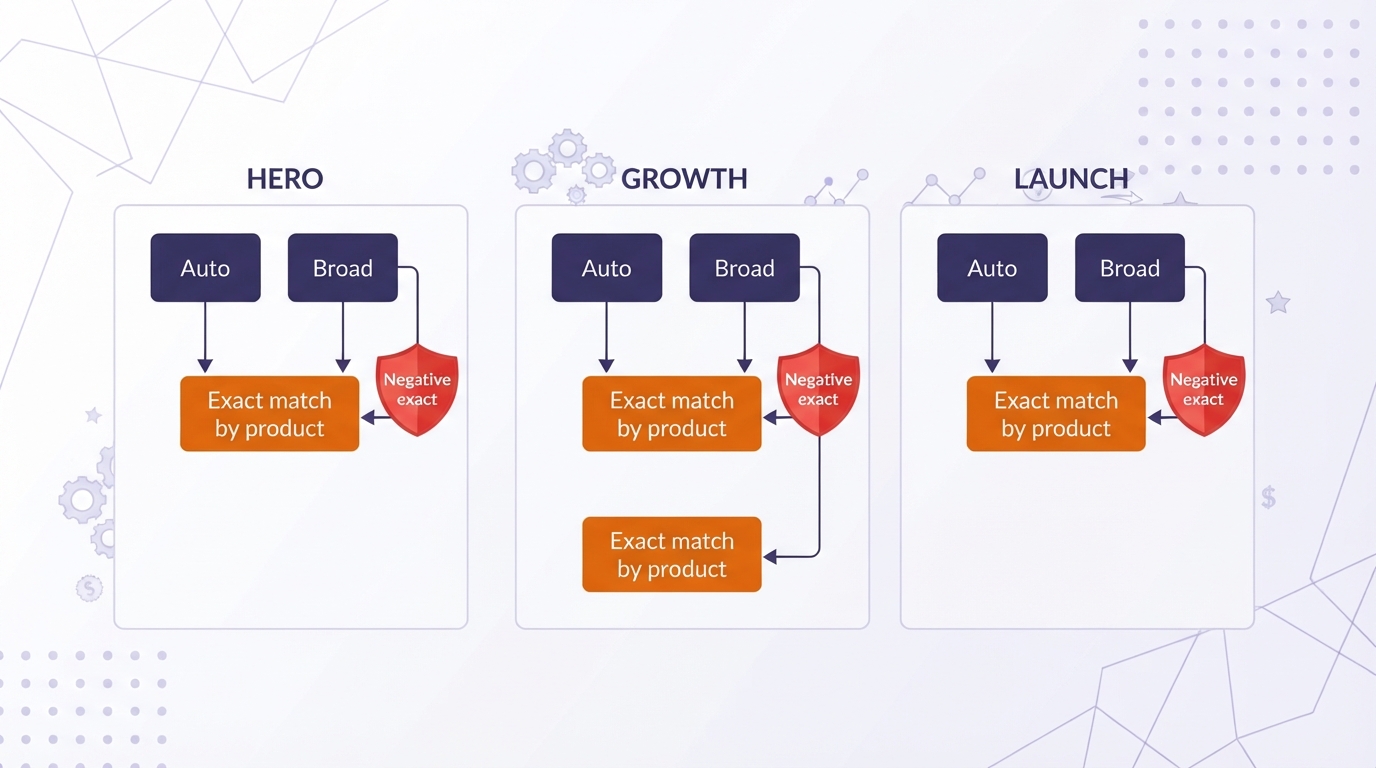
Stopping Your Campaigns From Competing
Overlap happens when the same search term spends in two or more campaigns for the same product. You pay twice for the learning, the data splits, and Amazon’s auction decides which of your own campaigns wins. A 20-minute check finds it:- Export the search term report for the last 30 days.
- Pivot by search term and campaign. Any term that spends in two or more campaigns for the same product is overlap.
- Pick one owner. Usually the exact match campaign for that product. Branded terms belong to the brand campaign.
- Add the term as negative exact everywhere else. Especially in auto and broad discovery campaigns. Our negative keywords guide covers match types.
- Recheck monthly. New overlap appears as discovery finds terms. Our search term optimization guide shows which terms to review first by share of spend.
Portfolios, Budgets and Naming
- One portfolio per product line. Reports and budget caps then match how you think about the business.
- Budget by role, not by campaign count. Decide what share of total spend each product role gets, then split it inside the portfolio.
- Use one naming pattern. Product | intent | match type | optional note. A name should tell you what a campaign does without opening it.
- Set targets per campaign type. Branded campaigns run at a low ACoS; discovery and competitor campaigns get a higher limit and a time box. Our bid strategy guide covers bidding settings per type.
Pause, Consolidate or Rebuild? Decision Rules
| What you see | Decision |
|---|---|
| Campaign spends under a few dollars a day and has too little data to optimize | Consolidate into a larger campaign for the same product and intent |
| Same search term spends in 3+ campaigns, owner unclear | Fix ownership with negative exact; rebuild only if this is widespread |
| Nobody can explain what half the campaigns do | Rebuild in stages, product by product, starting with the hero |
| Campaign above break-even for 30+ days with enough clicks to judge | Lower bids or pause the losing targets, not the whole campaign |
| Campaign profitable but limited by budget | Raise budget before adding new campaigns |
| Competitor campaign with no orders after a fair test | Pause it and test different competitor ASINs |
When NOT to Restructure
- During peak events. Do not rebuild before Prime Day or Black Friday. Fix overlap with negatives and wait.
- When the account is small and profitable. Two or three products with clear campaigns may not need more structure.
- When the real problem is the listing. Structure will not fix a product that does not convert. Check conversion rate first.
Related Reading
Frequently Asked Questions
What is the best Amazon PPC campaign structure?
For a multi-product brand, structure by product role (hero, growth, launch, long tail) and by search intent (branded, category, competitor, discovery). Use auto and broad campaigns for discovery, exact match for proven terms, and give every search term one owner campaign.Should I put all my products in one Amazon PPC campaign?
Not for proven keywords. Products with different margins, prices and goals need separate campaigns so each gets the right budget and target. Discovery campaigns can cover several products in separate ad groups.How do I stop my Amazon campaigns competing with each other?
Find search terms that spend in more than one campaign for the same product, choose one owner campaign for each, and add the term as negative exact in the others, especially auto and broad campaigns.How many campaigns should an Amazon seller have?
There is no right number. Each campaign should have a clear job, enough budget to collect data, and no overlap with another. Too many thin campaigns are as harmful as one campaign doing everything.When should I rebuild my Amazon PPC account?
When ownership of search terms is unclear across many campaigns, or nobody can explain what most campaigns do. Rebuild in stages, product by product, and avoid peak events.Are Your Campaigns Bidding Against Each Other?
Send us your store or ASIN. We map your campaigns by product and search intent, find where they overlap, and show you the structure changes that matter most.
Find My Campaign OverlapFree. No obligation. Useful findings even if we don’t work together.
Example result: ACoS cut from 76% to 28% in two months, with ad sales up 47%, for one client account. See the case study. Results vary by category, competition and listing quality.
Written by the AMZ Scaler Team
Amazon advertising and listing specialists with 5+ years managing PPC and listing optimization for brands across the US, UK, and Canada. We publish what we apply in real seller accounts every day.