
Quick Answer
Amazon’s 2027 US FBA fees rise by an average of $0.19 per unit (about 0.8% of the average selling price) from January 15, 2027, with some fees going up and others down (Amazon). From February 1, 2027, the storage utilization surcharge is removed, the aged inventory surcharge is folded into a single age-based monthly storage fee, and the low-inventory-level fee applies only below 28 days of supply. The fuel and logistics surcharge is unchanged. Check your products in the Fee Change Comparison dashboard, then recalculate break-even ACoS and max CPC for any product whose fees rise.
What Changed
| Change | Effective | What Amazon said |
|---|---|---|
| FBA fulfillment fees | Jan 15, 2027 | Average +$0.19 per unit (about 0.8% of ASP); some fees rise, some fall |
| Storage utilization surcharge | Feb 1, 2027 | Eliminated |
| Aged inventory surcharge | Feb 1, 2027 | Combined with monthly storage into one age-based rate; inventory that turns in under six months sees flat or lower fees |
| Low-inventory-level fee | Feb 1, 2027 | Applies only below 28 days of supply, based on shipments in the four weeks before and after the assessment date |
| Fuel and logistics surcharge | No change | Kept as introduced in April 2026 |
Holding slow stock? See how to clear aged inventory before February 1.
Amazon’s full fee summary sits in Seller Central. PPC Land, quoting it, reports these average changes by size tier and price band (PPC Land):| Product type | Under $10 | $10 to $50 | Over $50 |
|---|---|---|---|
| Small standard | +$0.20 | +$0.40 | +$0.70 |
| Large standard (non-apparel) | No change | +$0.12 | +$0.47 |
What It Means: Recalculate Your Max Profitable CPC
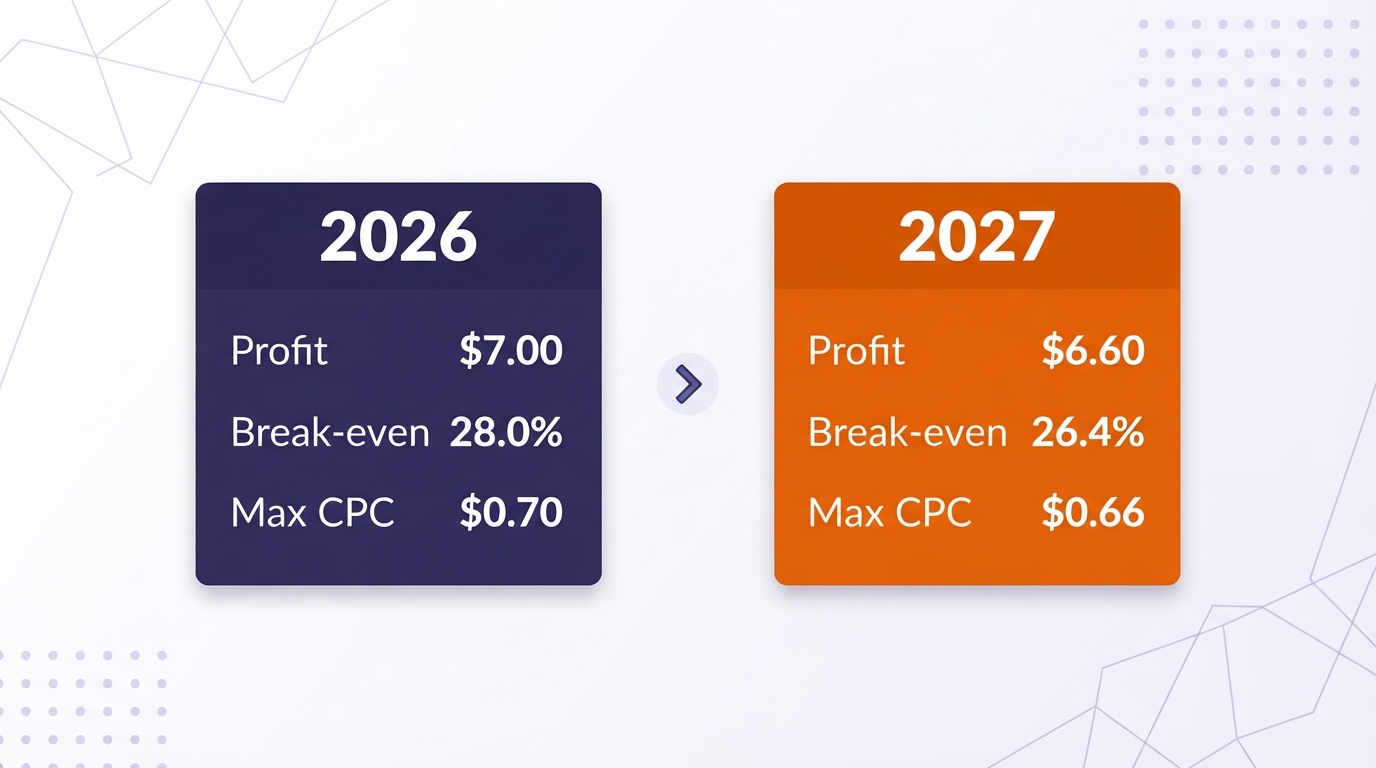
Every fee increase lowers profit before ads, which lowers break-even ACoS, which lowers the most you can bid. Here is an illustrative small standard product priced at $25 in the $10 to $50 band:| 2026 | 2027 | |
|---|---|---|
| Profit before ads | $7.00 | $6.60 (after +$0.40) |
| Break-even ACoS | 28.0% | 26.4% |
| Max CPC at 10% conversion | $0.70 | $0.66 |
What to Do Before January 15
- Run the Fee Change Comparison dashboard and list every ASIN whose fee rises more than a few cents.
- Recalculate break-even ACoS and max CPC for those ASINs and lower bid ceilings from January 15.
- Check fee categories and size tiers. A product near a size-tier boundary may move into a cheaper tier with a packaging change. Pair this with our post on the October 31 fee category change.
- Plan stock for February 1. Keep at least 28 days of supply to avoid the low-inventory-level fee, without overstocking slow movers that will pay the new age-based storage rate.For the ad side of stock planning, see our Amazon PPC inventory playbook: what to cut when stock runs low and how to restart after a stockout.
- Reprice where the math no longer works. Under-$10 items in the five affected categories are the most likely to need a price change.
- Remember peak. 2026 holiday peak fees run until January 14, so your fees change twice in a few weeks. See our Q4 peak fees guide.
Related Reading
Frequently Asked Questions
When do Amazon’s 2027 FBA fee changes start?
Fulfillment fee changes start January 15, 2027. Storage changes and the new low-inventory-level fee rule start February 1, 2027.How much are Amazon FBA fees going up in 2027?
Amazon says the average increase is $0.19 per unit sold, about 0.8% of the average selling price. Some products rise more, some less, and some fees fall, depending on size and price.How do I see my own 2027 FBA fee changes?
Use the Fee Change Comparison dashboard in Profit Analytics in Seller Central, and model scenarios in the Revenue Calculator.Will January’s Fees Break Your Bids?
Send us your store or ASIN. We rerun break-even ACoS and max CPC for the products hit hardest by the 2027 fees and show you which bids to lower before January 15.
Get My Free PPC ReviewFree. No obligation. Useful findings even if we don’t work together.
Example result: ACoS cut from 76% to 28% in two months, with ad sales up 47%, for one client account. See the case study. Results vary by category, competition and listing quality.
Written by the AMZ Scaler Team
Amazon advertising and listing specialists with 5+ years managing PPC and listing optimization for brands across the US, UK, and Canada. We publish what we apply in real seller accounts every day.
More in Amazon News & Trends
- Amazon Holiday Return Policy 2026: Returns Until January 31, Now Every Year →
- Amazon Liability Insurance Requirement: $1M Cover Now Needed in Safety Categories at Any Sales Level →
- Amazon Bundle Policy 2027: Seller-Built Bundles Must Comply by January 11 →
- Amazon’s 75-Character Title Limit Starts July 27: What to Do Now →